Nan McCarthy

author of Since You Went Away, Chat, Connect, Crash, & Live ’Til I Die

  • Home
  • About
  • Titles
    • Since You Went Away, Part Three: Summer
    • Since You Went Away, Part Two: Spring
    • Since You Went Away, Part One: Winter
    • Chat: book one
    • Connect: book two
    • Crash: book three
    • Coming Soon
    • Live ’Til I Die
    • Chat (1998 edition)
    • Connect (1998 edition)
    • Crash (1998 edition)
    • Quark Design
  • Excerpts
    • Live ’Til I Die: excerpt
  • Blog
  • News
  • Events
  • Shop
    • Buy: Since You Went Away (Part Three: Summer)
    • Buy: Since You Went Away (Part Two: Spring)
    • Buy: Since You Went Away (Part One: Winter)
    • Buy: Chat (book 1)
    • Buy: Connect (book 2)
    • Buy: Crash (book 3)
    • Buy: Live ’Til I Die
  • Contact
  • Amazon
  • iTunes
  • Facebook
  • Twitter

Tag: addiction

4 Mother’s Day Reflections

  • May 10, 2023
  • by Nan McCarthy
  • · Blog · Family · Featured · Parenting

“It’s far too easy, now that my sons are grown, to look back in hindsight and identify all the ways I could have been a better parent—how I could’ve handled various situations differently, or better, if only I’d had the necessary wisdom at the time.”

Nan McCarthy

Before I became a mom I knew pretty specifically the kinds of things I didn’t want to do as a parent, but beyond that my vision of what kind of mom I did want to be was a little less precise. I knew I wanted my children to feel safe and protected. I wanted to shower them with warmth and affection. I wanted them to grow up feeling good about themselves and the world around them. Above all, I wanted them to know that I loved them no matter what—that nothing in this universe could ever cause me to not love them.

The things I knew I didn’t want to do as a parent were, in my mind, more straightforward: I would never call my children names. I would never hit them. I would never degrade them. Give them the silent treatment. Compare them to other people or to each other. Make them feel unloved, or that my love for them was in any way conditional. More than anything, I would do my best to never become addicted to drugs or alcohol or gambling, because I didn’t want my children to grow up living in a state of fear—fear of the next blowup, the next crisis, the next humiliation.

I knew these were things I didn’t want to do as a parent because they are things I experienced as a child. It’s not something I like to dwell on, but it’s a fact I didn’t feel very safe growing up. My mom was not a terrible person—she was dealing with a lot due to my dad’s alcoholism. And I don’t believe my dad was a terrible person either. They were both just two damaged people trying to get through life.

So when it came to raising my own children, I’m at least thankful I didn’t repeat my parents’ mistakes. But let’s face it—that bar was pretty damn low to begin with! And as the saying goes, once I became a parent myself, I made my own, new mistakes. In my efforts to make my children feel safe and protected, I went overboard at times shielding them from life’s challenges and inequities, trying to solve their problems for them when I should have let them figure things out on their own. Other times I wish I was more protective of my sons, wondering if I could have prevented any number of struggles life had in store for them.

Sometimes I put so much pressure on myself to be a good parent I didn’t allow myself the time or mental space to just enjoy being a parent. Don’t get me wrong—we had a lot of fun times as a family. But on a day-to-day level, it’s easy to get so caught up trying to meet your own expectations (and those of others) that you forget to allow yourself to be in the moment. To let the house be messy and instead of cleaning, go outside and make more snow angels or sit on the family room floor and play another round of Hi-Ho Cherry-O.

It’s far too easy, now that my sons are grown, to look back in hindsight and identify all the ways I could have been a better parent—how I could’ve handled various situations differently, or better, if only I’d had the necessary wisdom at the time. It’s hard not to let these types of thoughts crowd out the memories of the things I did right as a parent, the fun times we shared as a family, the myriad ways we supported each other and let our love be the glue that held us together during the difficult times. But I try. It helps to continue making new memories, because having fun together is the best reminder of how much we’ve flourished in spite of our hardships.

Once your children become adults, parenthood presents an entirely new set of challenges. You want them to be independent and self-sufficient, yet you also want to remain close with them emotionally if not geographically. It becomes a balancing act of respecting their need to have their own lives, yet also wanting to feel a part of their lives in a way that’s healthy and fulfilling for everyone. 

No matter where you’re at in life, parenthood is a journey into uncharted waters. With new challenges come new mistakes to be made. The good news is that with each new mistake, you get the opportunity to learn and do better. There will come a time when your children no longer need to be parented. But that doesn’t mean they’ll no longer need you. It just means you’ll have to learn new ways of being there for them. I had hoped to have everything figured out by this point in my life. The truth is, I’m still learning. 

copyright © 2023 Nan McCarthy

Enter your email address to subscribe to this blog and receive notifications of new posts by email.

  • Tweet
  • Click to email a link to a friend (Opens in new window) Email
  • Share on Tumblr
  • Click to share on Reddit (Opens in new window) Reddit
Like Loading...

7 For the Ones Who Startle Easily

  • January 15, 2021
  • by Nan McCarthy
  • · biography/memoir · Blog · Books · Family · Featured · Live ’Til I Die · Parenting

“Nowadays, when I look back on that day my dad died 50 years ago, what strikes me the most is not the memory of my own sadness, but the faces of the people who cared for me.”

Nan McCarthy

My dad died 50 years ago today, January 15, 1971. I was nine years old. I remember walking home from Macarthur elementary school on that cold snowy afternoon in South Holland, Illinois. I was about half a block away from our house when my mom passed me in my dad’s red Chevy Malibu. She slowed the car and waved to me. I’ll never forget her face. She smiled but her eyes were sad.

As I came through the front door I could see my Nana in the family room, crying while she mopped the tiled floor. She paused when she saw me, still holding onto the mop, her cheeks stained with tears. My Papa milled about behind her, hands in his trouser pockets. He was crying too.

I made my way to the kitchen, where my mom and older sister had already gathered. My mom asked my sister and I to have a seat at the kitchen table. She sat across from us and said, “Your dad went to heaven today.” She’d obviously been crying but at this moment she was composed. She delivered the news gently but matter-of-factly. More than anything, she looked exhausted. 

Learning of my dad’s death was not a surprise to me. He’d been in and out of hospitals for months, battling alcoholism the last several years of his life—a battle that had most likely begun before I was even born. In the years leading up to his death the battle that raged within our house and within his body was intense, violent, and bloody. Only after I became an adult did I understand my dad was just as much a victim of his addiction as my mom, sister, and I were. 

Anyone who has lived with and loved an addict knows the particular, slow-motion horror of watching helplessly as the person you love is destroyed from within. It’s an epic battle that is sometimes won, and oftentimes lost. Thirty years after our dad’s death, as my sister and I took care of our mom while she was dying of cancer, I had the same feeling of watching someone being eaten alive from the inside. The difference between cancer and addiction is that most people find it easier to empathize with the person dying from cancer. It’s harder to empathize when the person suffering from addiction leaves behind a trail of arrest records, restraining orders, DUIs, totaled cars, gambling debts, barroom brawls, damaged careers, lost friendships, broken marriages, domestic violence, traumatized children. 

It wasn’t until a therapist explained it to me in my early 30s that I came to realize I had grown up in a war zone. Looking at my childhood through that lens explained a lot of the things I experienced as a young adult—the sleepless nights, the nightmares, the anger that seemed to come out of nowhere, the feeling of not being able to trust my own happiness because I was in a perpetual state of high alert, bracing myself for the inevitable crisis that was most assuredly lurking around the next corner and would rear its ugly head the moment I allowed myself to relax. 

The irony that I married a man who served 29 years in the Marine Corps, who deployed to geographic war zones while I continued to work to overcome the fallout of growing up in a familial war zone, has not escaped me. Of the two of us, I’m the one who startles easily, who needs to sit facing the exit in a restaurant, who remains vigilant when I have every reason to sit back and relax. On the upside, I tend to be extraordinarily calm in crisis situations. The ability to focus on practical matters during life’s various emergencies can be handy at times, yet that sense of calm in the eye of the storm also comes at a cost—unlike my husband, who’s very much in touch with his emotions in the moment, it often takes me days, weeks, months, or even years to come to terms with the normal range of emotions stemming from various life events.

Nowadays, when I look back on that day my dad died 50 years ago, what strikes me the most is not the memory of my own sadness, but the faces of the people who cared for me. In their eyes I saw concern, love, grief—not for themselves, but for the two little girls who just lost their dad. Remembering their faces is the thing that makes me cry. I imagine how difficult it must have been for them as parents and grandparents, the worry and responsibility they felt for the impact this day, and the years leading up to this day, would have on the lives of two little girls. Through them, I learned one of the most valuable emotions in life—after hope—is empathy. When bad things happen, it’s hope that propels us to keep getting out of bed every morning when our instinct is to stay burrowed underneath the covers, and empathy that allows us to close our eyes every night to slumber in peace, knowing we are not alone. 

I’m 59 now, and still reminding myself to take that deep breath, live in the moment, embrace my own happiness. Because I have a lot to be happy for. Life continues to present us with challenges at every turn, as it does for all of us.  And that’s another gift that cold snowy day in 1971 gave me—the knowledge in my bones that each of us is fighting an epic battle, that nothing is permanent, that hope and empathy sustain us.


Ben Johnson

July 25, 1931 — January 15, 1971

copyright © 2021 Nan McCarthy

Enter your email address to subscribe to this blog and receive notifications of new posts by email.

  • Tweet
  • Click to email a link to a friend (Opens in new window) Email
  • Share on Tumblr
  • Click to share on Reddit (Opens in new window) Reddit
Like Loading...

7 The Last Time I Saw My Dad Alive

  • December 12, 2014
  • by Nan McCarthy
  • · Blog · Family · Live ’Til I Die · Parenting

Christmas Day 1970, Our Lady of Mercy Hospital, Dyer, Indiana.

Nan McCarthy

I was nine when our mom took my sister and me to the hospital on Christmas Day to visit our dad. It was the last time we’d see him alive. He died three weeks later of alcoholic cirrhosis. He was 39 years old.

We knew at the time he was very sick. In fact, I remember curling up with my mom in my dad’s favorite oversized green chair one night before Christmas, my head in her lap, Christmas lights twinkling. He’d been hospitalized several times before. “I don’t think he’s going to make it this time,” she told me.

The Intensive Care Unit was decorated for Christmas, and one of the nurses had put a Santa hat on my dad’s head. He was awake, sitting up in his hospital bed. He tried to smile at us, but even at that young age I could see the sadness in his eyes. I don’t think I touched him. I was afraid of all the tubes and how sick he looked.

For many years afterward, Christmas never felt real to me. The happiness seemed forced, superficial. Sure, getting presents was fun. But there was no joy in it. During Midnight Mass, my mom cried.

Then I fell in love and got married. A family of my own. New memories to make. At first it was just my husband and me, a few gifts around a Charlie Brown Christmas tree. But our love was plentiful and genuine. Then our sons were born. More memories to be made. My mom in her pink terrycloth bathrobe, watching us open gifts on Christmas morning, a cup of coffee in her hand and a smile on her face. New traditions, like the Santa footprints in front of the fireplace and a birthday cake for baby Jesus. Our boys jumping up and down in their pajamas, giddy with excitement. Pure joy on their faces. Pure joy in my heart.

Christmas is real to me now. But I’ve learned it’s not just about the happy times. Like any family, we’ve had our share of sad times during the holidays. Living far away from loved ones, missing out on annual family get-togethers. Christmases when one or both of us were without a job and money was tight or nonexistent. My mom’s last Christmas when she was in hospice at our house, knowing it wouldn’t be long before she, too, was gone. The year Christmas was just the boys and me, when Pat was serving in Iraq for thirteen months, his only physical contact a hug from the USO lady on Christmas Day.

I’ve come to realize that even though Christmas didn’t feel real to me when I was young, it was every bit as real then as it is now. It’s just that life and death, sickness and loneliness and tragedy don’t take time off for the holidays.

It’s no wonder Christmas lights, Midnight Mass, and Santa hats held a particular sadness for me as a child. But now I understand how much those seemingly superficial efforts at holiday cheer during the end of my dad’s tragic life mattered. “We’re not giving up on Christmas,” they said. The Santa hat mattered because it held hope. Hope that next year would be better (and if not next year, the year after that). Hope that a frightened little girl would one day make a better life for herself than the hand her mom had been dealt. That she wouldn’t fall prey to addiction the way her father had, even though her DNA was stacked against her. That she would one day find someone who loved and respected her, and together they would bring new life into the world. That they would raise their children to be better human beings than they were, leaving the world a little kinder than they found it.

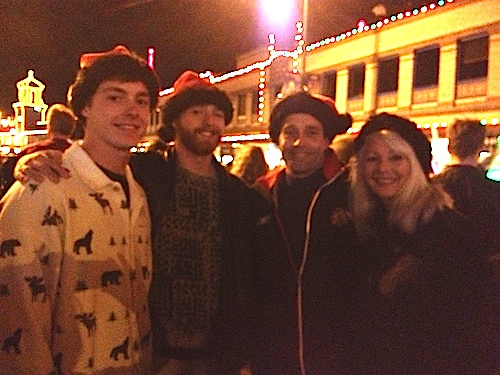
plaza lights 2012 w: santa hats

copyright © 2014 Nan McCarthy

Enter your email address to subscribe to this blog and receive notifications of new posts by email.

  • Tweet
  • Click to email a link to a friend (Opens in new window) Email
  • Share on Tumblr
  • Click to share on Reddit (Opens in new window) Reddit
Like Loading...

1 Live ‘Til I Die: a memoir of my father’s life

  • December 6, 2001
  • by Nan McCarthy
  • · biography/memoir · Blog · Books · Live ’Til I Die · Titles

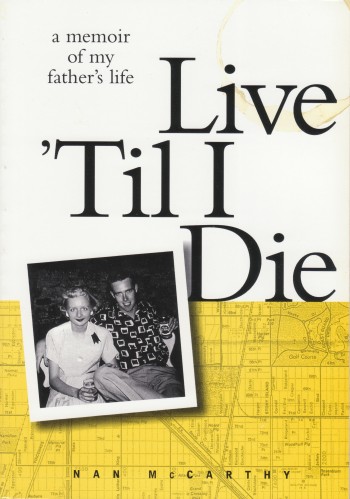
Live ’Til I Die: a memoir of my father’s life
Nan McCarthy
(Rainwater Press, 2001) 246 pages, $14.95

In its opening pages, the final days of 39-year old Ben “Buddy” Johnson’s life are chronicled in excruciating detail through the eyes of ICU nurse Maggie Quinn. Here is the story of an alcoholic who doesn’t come out the other side—a brilliant, charismatic young man who comes of age on Chicago’s South Side in the 1940s and ‘50s, rises to prominence in his career as a trade-show executive at the Chicago Amphitheatre and McCormick Place in the 1960s, and dies horrifically of alcoholic cirrhosis in 1971, leaving a wife and two young daughters.

Thirty years later his youngest daughter sorts through the pieces of her father’s life by interviewing his boyhood friends. Through their alternately humorous and heart-wrenching stories, she learns about the man her father was before his mind and body were overcome by alcoholism. At once harrowing and hopeful, Live ‘Til I Die confronts the physical and emotional devastation wrought by chronic alcohol abuse—yet manages to offer up love, laughter, and tears while allowing a daughter to restore the memory of a father she barely knew.

“Studs Lonigan meets The Liar’s Club”

“Charts new territory in the field of addiction memoirs”

Click here for purchase information for Live ’Til I Die.

Enter your email address to subscribe to this blog and receive notifications of new posts by email.

  • Tweet
  • Click to email a link to a friend (Opens in new window) Email
  • Share on Tumblr
  • Click to share on Reddit (Opens in new window) Reddit
Like Loading...

Website Powered by WordPress.com.

  • Amazon
  • iTunes
  • Twitter
  • Facebook
  • Subscribe Subscribed
    • Nan McCarthy
    • Join 129 other subscribers
    • Already have a WordPress.com account? Log in now.
    • Nan McCarthy
    • Subscribe Subscribed
    • Sign up
    • Log in
    • Report this content
    • View site in Reader
    • Manage subscriptions
    • Collapse this bar
 

Loading Comments...
 

    %d