Nan McCarthy

author of Since You Went Away, Chat, Connect, Crash, & Live ’Til I Die

  • Home
  • About
  • Titles
    • Since You Went Away, Part Three: Summer
    • Since You Went Away, Part Two: Spring
    • Since You Went Away, Part One: Winter
    • Chat: book one
    • Connect: book two
    • Crash: book three
    • Coming Soon
    • Live ’Til I Die
    • Chat (1998 edition)
    • Connect (1998 edition)
    • Crash (1998 edition)
    • Quark Design
  • Excerpts
    • Live ’Til I Die: excerpt
  • Blog
  • News
  • Events
  • Shop
    • Buy: Since You Went Away (Part Three: Summer)
    • Buy: Since You Went Away (Part Two: Spring)
    • Buy: Since You Went Away (Part One: Winter)
    • Buy: Chat (book 1)
    • Buy: Connect (book 2)
    • Buy: Crash (book 3)
    • Buy: Live ’Til I Die
  • Contact
  • Amazon
  • iTunes
  • Facebook
  • Twitter

Tag: family

1 Chocolate Cake

  • January 15, 2026
  • by Nan McCarthy
  • · Blog · Family · Featured · Recipes

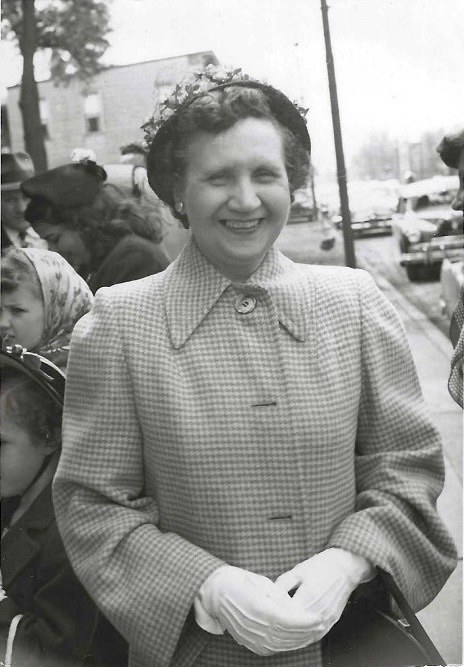
Remembering My Nana (& her chocolate cake) on the anniversary of her death, 34 years ago today.

Nan McCarthy

Frances Hyzy Morris (my mom’s mom) was born in Krakow, Poland on March 3rd, 1905. In the century leading up to my Nana’s birth (and after), the people of Poland were being oppressed by both Russian and German occupiers. Polish secret societies were formed to resist the occupiers and preserve the Polish national identity. These revolutionaries endured constant surveillance and persecution, including Russian campaigns aimed at suppressing Polish Roman Catholics in particular.

I mention these historical tidbits for a reason, as they clearly made an impression on my Nana as a young girl, before her family fled Poland along with millions of other Poles in the early decades of the 1900s. Fast-forward many decades later, when my Nana was in her early 70s. She had suffered a psychotic break following a stroke, and had to be placed in a skilled nursing facility called Rest Haven (in South Holland, IL) for a month or so. I was in high school then and would drive the short distance up South Park Avenue to visit her after school. One afternoon as she and I were sitting in her room having what I thought was a casual conversation, my Nana suddenly rose from her chair and crept a few steps toward me. Looking furtively around the room, she put her index finger to her lips, tilted her head toward an interior wall, and whispered, “Shhhh—they’re listening.” “Who’s listening, Nana?” I asked. Again she tilted her head toward the wall, as if to indicate there were people on the other side eavesdropping on our conversation. As a teenager I found this incident disconcerting, but I also understood it wasn’t just random paranoia, because I knew about my Nana’s family history. Yes, she’d been experiencing a break from reality, but you didn’t have to be a genius to connect whatever was going on in her mind to the things she must have seen and experienced in her formative years before she and her parents left Poland.

This episode was a turning point in my relationship with my Nana, because until this happened, my Nana had been my rock, the most stabilizing influence of my life. At 5’3”, she was short and slightly plump, with cornflower blue eyes that twinkled when she laughed. She was tiny but mighty—if you were to look up the phrase “walks softly and carries a big stick” in the dictionary, you might find a photo of my Nana. Not that I ever saw her angry. She was just one of those people who didn’t need to be unpleasant to let you know there was a real badass lying in wait underneath her jolly exterior. Mostly, she laughed a lot. In fact I can hardly remember a time when my Nana wasn’t smiling or laughing. The only time I saw her cry was the day my dad died. I had come home from school—having no idea of the news that awaited me—to find her mopping our family room floor with tears streaming down her face.

Speaking of mopping, my Nana was an exceptionally clean person. She and my Papa rented an apartment on the second story of a four-flat on E. 79th and S. Coles Ave. in the South Shore neighborhood of Chicago. The building was owned by my Nana’s brother, Uncle Stan Hyzy, and his wife Aunt Edna. (Aunt Edna scared the hell out of us younger kids. She was a mean-looking woman with a spirit to match. Family lore had it Aunt Edna would cast spells on the people she didn’t like. I stayed out of her way as much as possible so as not to be the subject of one of her spells.) After my Nana cleaned the inside of their apartment to her liking, she would bring her broom outside to the front of the building to sweep the dirt from the curb on their side of the street. (Imagine what the world would be like if everyone took care of their own side of the street the way my Nana did.)

She was also big on personal hygiene. I remember her frequently admonishing my sister Gerarda to go wash her elbows. (Were Gerarda’s elbows exceptionally dirty? Why wasn’t I, too, told to go wash my elbows? And how does one get one’s elbows dirty anyway?) My Nana’s short brown hair (and later gray) always looked like she’d just been to the salon, and while she didn’t wear much makeup, she invariably carried rose-colored lipstick in her purse, along with the ever-present Clorets for fresh breath & Rolaids for her “sour stomach.” I rarely saw my Nana in anything but a dress, stockings, and leather pumps, along with earrings, necklace, and a bracelet to match. (I wore one of her Bakelite bracelets for years until a piece fell out at a military ball, never to be found again.) Other than dresses, my Nana would sometimes put on a housecoat over her girdle & stockings (swapping out the pumps for house slippers), but only when she was at home cleaning or cooking.

She was one of ten children (either the oldest or second oldest, I can’t remember), and at some point after the family settled in Chicago, Frances quit school in third grade to help care for her younger siblings. When the youngest sibling (I think it was Uncle Cass) was still a baby, their father was killed at work in a steel mill accident. After that my Nana’s help with the younger children became even more necessary. In spite of her lack of education, she eventually worked her way up to become head of payroll at Woolworth’s department store on State Street in downtown Chicago. She never learned to ride a bike or drive a car, so she either walked or took public transportation everywhere she went (that is, if my Papa wasn’t driving her). I remember walking with my Nana all around their South Shore neighborhood—to the grocery store, St. Bride’s Church (where the Masses were still said in Latin), and Rainbow Beach. We would take the bus downtown so my Nana could take me shopping at Marshall Field’s. (Sometimes these trips included both my sister and me; other times we each got a solo trip with just Nana.) We did this at least twice a year, once at the start of the school year to buy school clothes (with lunch at The Berghoff afterward—my Nana’s favorite) and again at Christmas time to look at the window decorations and have lunch in the Walnut Room. On these excursions my Nana would keep her cash in a small cloth pouch she kept tucked inside her bra, a safety measure in case her purse got stolen. She’d come in the dressing room with me to dig out her cash before we went to the register to make our purchases. (I also remember her storing money in their freezer at home. She called it her “cold cash.” Perhaps this is where I inherited my penchant for storing ten-dollar bills in coffee cans.)

Frances became a U.S. citizen in 1940 when she was 35 years old. (My mom would’ve been six or seven at the time.) To me, my Nana epitomizes all that is good in our world. Her childhood—fleeing oppression in Poland, immigrating to America, losing her father at a young age, helping her mom raise her siblings—must have been incredibly difficult. And yet, with very little schooling, she managed to have a successful career in which she was entrusted with managing the payroll of a large department store in downtown Chicago. Her marriage to my Papa couldn’t have been easy either—he was known to be a gadabout—but Frances was a devout Catholic and leaving her husband wasn’t an option. I do know that after my Nana gave birth to my mom, she looked my Papa in the eye and said, “I will never do that for another man again.” And she kept her word. Ha!

In spite of the hardships my Nana experienced, she was unfailingly polite and pleasant to everyone, no matter the circumstances. Even after she had to go back to living in a nursing home in her 80s due to the progression of Parkinson’s Disease and dementia, she would smile and nod and say hello and ask people how they were doing, whether they were nursing home staff, family, or complete strangers. (On these visits I’d bring her two White Castle hamburgers and a chocolate shake, another one of her favorites.)

When Gerarda & I were little, our Nana would come to the house (we lived on 98th & Dobson in Cottage Grove Heights) to take care of us while our parents worked. Even after our Nana stopped taking care of us during the day, she remained a steady presence in our lives. Gerarda and I spent many overnights at our Nana and Papa’s apartment in Chicago, and they frequently came to our house for Sunday dinner in addition to all the holidays. Later, when I was in my early teens, my mom and step-father bought a small house in Lansing for my Nana and Papa, and I would ride my bike the five miles from our house to theirs just to hang out and visit with them. (That was the first house my Nana and Papa ever lived in—they rented apartments their whole lives. When Gerarda and I slept over at Nana & Papa’s apartment in South Shore, we slept on the same trundle bed in the dining room our mom slept on as a child. Not only did both our parents grow up living in apartments, our mom never even had her own bedroom.)

My Nana was a fabulous cook, and she passed along her cooking skills to my mom, who also loved to cook. Frances was known for her mashed potatoes, homemade bread, and chocolate cake. She also made the best fried bologna sandwiches in the universe (two thick slices of bologna fried until the edges are burnt, two slices white bread, one side with mustard & the other slathered in butter). Nana’s chocolate cake was legendary, though, to the point it was the last food my dad requested in the hospital before he died. Here’s her recipe (with my notes / variations in parentheses):

Nana’s Chocolate Cake

⁃ 1/2 lb Imperial margarine, softened (I use 2 sticks regular salted butter)

⁃ 1 cup granulated sugar (I also add 1/2 cup brown sugar)

⁃ 1 egg

⁃ 5 tsp. Hershey’s Cocoa powder

⁃ 1 cup sour milk* (I use 1 cup sour cream or plain Greek yogurt instead—making sour milk without curdling it is an art form, see below)

⁃ 1 tsp. baking soda

⁃ 1 tsp. baking powder

⁃ 1 heaping cup flour

⁃ 1/2 tsp. salt

⁃ 1 tsp. vanilla

⁃ (This isn’t written in my Nana’s original recipe but I swore she added instant coffee, so I add 1 Tbsp. powdered instant coffee)

Cream butter with a fork in a large bowl. (My Nana & mom always used a fork and some elbow grease instead of an electric mixer, and I also do the same. Feel free to user a mixer though, if you want to be wimpy about it.) Add egg, vanilla, cocoa, & mix thoroughly. Then add sour milk & baking soda mixture OR sour cream / yogurt & baking soda. Add salt, baking powder, & flour. Mix well. Pour mixture into greased Pyrex casserole dish and bake at 350 degrees about 30-40 minutes, until toothpick comes out clean. Let cool completely before frosting.

frosting:

⁃ 2 Tbsp butter, softened

⁃ 2 tsp. cocoa powder

⁃ 2 cups powdered sugar

⁃ 1 shot coffee (this was definitely in the original recipe—I use espresso instead of coffee)

⁃ extra powdered sugar and / or milk as needed for right consistency

*sour milk: Heat 1 cup regular milk in a small soup pan over low heat to lukewarm, SLOWLY add 1 Tbsp. vinegar while stirring—if you do this too quickly it will curdle. Add baking soda to sour milk & mix well before combining with other ingredients.

When I think of my Nana I remember her laughter. She exuded merriment. She was always one to appreciate a funny story and have a good laugh, even if it was at her own expense. She took great care with her appearance, yet she was humble. She was rock solid. She was patient, loving, kind, hard-working, and determined. She was the strongest woman I’ve ever known. She died when she was 86, on January 15, 1992—the same day of the same month my dad died 21 years earlier. If there’s one person in this world I’ve strived to emulate, it would be my Nana.
copyright © 2026 Nan McCarthy

Enter your email address to subscribe to this blog and receive notifications of new posts by email.

  • Tweet
  • Email a link to a friend (Opens in new window) Email
  • Share on Tumblr
  • Share on Reddit (Opens in new window) Reddit
Like Loading...

0 Live ’Til I Die: Student Interview

  • November 6, 2016
  • by Nan McCarthy
  • · biography/memoir · Blog · Books · Family · Featured · Live ’Til I Die · Writing

Occasionally I receive inquiries from students who’ve been assigned the unfortunate task of keeping a dialectical journal or writing a paper on one of my books. I love chatting with students and I always make an attempt to answer student emails when time allows. Here’s an interview with a high school student in Chicago who read Live ’Til I Die for her AP English class.

Nan McCarthy


Student: I wanted to know a little more about the last section of every chapter. From what I can tell it looks like a switch from the actual memoir to an update of the present day. Was the intention of adding these parts in the book more for the reader or for yourself? I personally liked reading the process that you went through trying to bring this book together.

Nan: Yes—the first-person interludes at the end of each chapter are updates from the present day (“present day” being the two-year period in which I wrote the book, 2000-2001). Although my main purpose in writing Live ’Til I Die was to tell my father’s story, the secondary story (intertwined with my father’s story) was my attempt to put the pieces of his life together and therefore gain a better of understanding of who he was. With this perspective in mind you can’t really have one without the other. If it was just a straight-up account of my father’s life it would have been a biography. That’s why the book is subtitled “a memoir of my father’s life”—because by using the term “memoir,” it’s understood that the telling of his story comes from a very personal place, colored by my relationship with him as his daughter as well as by his relationships with his friends.


Student: Reading your book was nothing like anything I have ever read. I enjoyed the format in which the stories were told and how you had each chapter in chronological order. Not that I had a problem with it, but were there any times in which you felt as though the stories overlapped too much and it seemed repetitive? Was this on purpose to emphasize that certain events actually happened?

Nan: The way the various voices were arranged and edited was extremely purposeful. I had hours upon hours of tape recordings of interviews with each person who knew my father. I transcribed these recordings verbatim, then printed out the transcriptions and made comparisons between and among the various viewpoints, finding patterns and common themes as well as discrepancies. As the story of my father’s life began to take shape through the cumulative telling of each person’s story, my goal was to accurately convey the key events and emotions presented by each person.

I never doubted the veracity of the events as they were described to me so no, the repetition was not meant as a means of corroboration—although by their very nature those shared recollections did ultimately serve as a sort of corroboration. And while many of the interviewees talked about the same events, the fact that each person’s recounting of that event came out slightly different was fascinating to me. People have different memories of shared events because we each recall and interpret a particular event based on our various life experiences, personalities, and world views. With that in mind I find it remarkable that the stories my dad’s friends told me were as similar as they were. I believe those similar perspectives are a result of my dad’s friends’ shared upbringing and cultural backgrounds in a very specific place (Chicago’s South Side) at a unique moment in time (1940s, ’50s, and ’60s).


Student: You clearly state that your goal “from the start was to explore a world beyond [your] own memories of [your] father, to get to know him through the eyes of his peers” (231), which is what you did. I cannot even imagine how much work that might have been! I bet it was such a rewarding experience for you to see all of it come to together in the end.

I know you must be super busy so I’ll try to keep this short. I would love to know more about your use of rhetorical devices. Specifically speaking, when Maggie Quinn said, “Of course, it was tempting to want to ask such patients, ‘How could you do this to yourself?’ and to ask the family, ‘Why did you let it get to this point?’’ (11), was this an appeal to pathos? If you could direct me to a few more examples that would be great.

Nan: I appreciate the citations! Yes, writing Live ’Til I Die was an incredibly rewarding and satisfying experience. It was also surprisingly uplifting. A lot of people might think writing a book about my father dying so tragically at such a young age would be depressing but it really wasn’t like that for me. Of course I am always sad at the loss of him, but the experience provided me with a sense of compassion for my dad that I didn’t have before I wrote the book—and coming from a place of compassion is always uplifting.

Re: rhetorical devices and pathos. I don’t think much about literary devices when I’m writing (and I’d venture to say it’s the same for most writers). Although it helps to have knowledge and understanding of such devices, when it gets down to the actual writing of a novel (or memoir, in this case) I’m going by instinct, trying to find the words and sentences that will most accurately and efficiently convey a particular scenario, emotion, or thought. When I’m writing I’m not thinking “Oh, a rhetorical device or an appeal to pathos would work well here.” That’s not to say that an after-action study of a particular work is pointless. As a student of literature it’s necessary for your understanding of the writing process and of the work itself to break it down and understand the various devices being used. But as a writer I’m not consciously thinking of anything but putting words and sentences together in a way that best expresses what’s happening in my head.

What I do consciously think about is the rhythm of the words I’m writing, which is why I often read my work aloud as I’m working. If I verbally stumble over a word or phrase, it’s a sure sign it needs to be written more efficiently. The other thing I’m conscious of when writing is using my words in the sparest way possible. I’m always searching for the simplest, most direct way to evoke whatever is going on in my brain. This is more a matter of style and the way I like to write; other writers take different approaches and that’s what makes it fun to read books by a variety of authors.

With that in mind I don’t think I could provide you with specific examples of particular literary devices in my own work because I haven’t studied my work from that perspective. Everything that’s there was written instinctively and whatever literary devices I may have used were entirely subconscious. Having said that, if you’d like to ask me about particular passages I am happy to explain my thought process at the time of writing each scene.

Regarding the specific example you mentioned where nurse Maggie Quinn says it’s tempting to ask how an alcoholic can do this to himself or how a family can let it [alcoholism] get to that point, these are common themes and questions that often come up among people who haven’t personally experienced addiction (either within themselves or with a loved one). I felt these questions in particular were important to reference because it’s natural to wonder how a person like my dad, who appeared to have everything—intelligence, good looks, successful career, loyal friends and a loving family—could throw it all away because of an addiction. This is really one of the key questions in the book and by having the nurse frame these issues right up front it’s setting the tone for everything that follows.

One of the main reasons I used the nurse’s perspective to bookend my father’s story is that I wanted to showcase the physical effects of alcohol addiction. Most addiction memoirs focus on the social and emotional fallout of addiction (losing a job, losing friends, divorce, legal trouble, etc.) but I don’t know of any other (non-medical) book that goes into such detail about what alcohol addiction does to a person’s body physiologically. This is why I took the time to interview a real-life ICU nurse who had experience treating alcoholic patients. Understanding the absolute horror of how a person’s organs deteriorate due to prolonged alcohol abuse really speaks to the power addiction has over a person and helps answer the questions mentioned above.

So to answer your question, no, it wasn’t an appeal to pathos so much as acknowledging a very basic, universal, philosophical question behind our desire to understand how a person becomes an addict, why it’s so difficult to overcome addiction, and why some people are able to recover while others aren’t. The second question (how can family members let it get to this point) acknowledges the genuine helplessness family members experience as they witness a loved one being destroyed by an addiction. The interviews with my dad’s family and friends that follow the prologue illustrate perfectly how one can witness someone crossing over to addiction and not even realize it, then being absolutely powerless to change the course of events once the addiction has taken hold of a person.


Student: And lastly this is more of a ‘thank you’ than anything. I appreciate that you added pictures of your family and of your father’s friends. I used it as reference when I was reading and it was nice to have a face with most names.

Nan: Thank you—I’m glad you enjoyed the photos. They are a treasure to me.


Roger Laven, Bill Caho, Ben Johnson, Dick Crimmins, Al Young


copyright © 2016 Nan McCarthy

Enter your email address to subscribe to this blog and receive notifications of new posts by email.

  • Tweet
  • Email a link to a friend (Opens in new window) Email
  • Share on Tumblr
  • Share on Reddit (Opens in new window) Reddit
Like Loading...

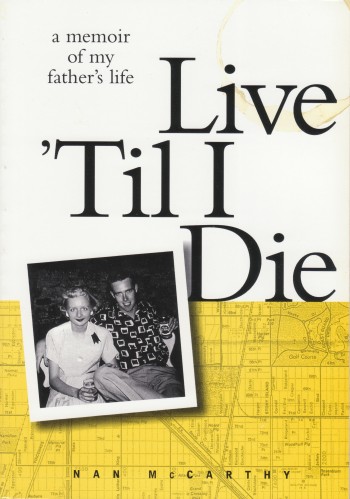
1 Live ‘Til I Die: a memoir of my father’s life

  • December 6, 2001
  • by Nan McCarthy
  • · biography/memoir · Blog · Books · Live ’Til I Die · Titles

Live ’Til I Die: a memoir of my father’s life
Nan McCarthy
(Rainwater Press, 2001) 246 pages, $14.95

In its opening pages, the final days of 39-year old Ben “Buddy” Johnson’s life are chronicled in excruciating detail through the eyes of ICU nurse Maggie Quinn. Here is the story of an alcoholic who doesn’t come out the other side—a brilliant, charismatic young man who comes of age on Chicago’s South Side in the 1940s and ‘50s, rises to prominence in his career as a trade-show executive at the Chicago Amphitheatre and McCormick Place in the 1960s, and dies horrifically of alcoholic cirrhosis in 1971, leaving a wife and two young daughters.

Thirty years later his youngest daughter sorts through the pieces of her father’s life by interviewing his boyhood friends. Through their alternately humorous and heart-wrenching stories, she learns about the man her father was before his mind and body were overcome by alcoholism. At once harrowing and hopeful, Live ‘Til I Die confronts the physical and emotional devastation wrought by chronic alcohol abuse—yet manages to offer up love, laughter, and tears while allowing a daughter to restore the memory of a father she barely knew.

“Studs Lonigan meets The Liar’s Club”

“Charts new territory in the field of addiction memoirs”

Click here for purchase information for Live ’Til I Die.

Enter your email address to subscribe to this blog and receive notifications of new posts by email.

  • Tweet
  • Email a link to a friend (Opens in new window) Email
  • Share on Tumblr
  • Share on Reddit (Opens in new window) Reddit
Like Loading...

Website Powered by WordPress.com.

  • Amazon
  • iTunes
  • Twitter
  • Facebook
  • Subscribe Subscribed
    • Nan McCarthy
    • Join 129 other subscribers
    • Already have a WordPress.com account? Log in now.
    • Nan McCarthy
    • Subscribe Subscribed
    • Sign up
    • Log in
    • Report this content
    • View site in Reader
    • Manage subscriptions
    • Collapse this bar
 

Loading Comments...
 

    %d