Nan McCarthy

author of Since You Went Away, Chat, Connect, Crash, & Live ’Til I Die

  • Home
  • About
  • Titles
    • Since You Went Away, Part Three: Summer
    • Since You Went Away, Part Two: Spring
    • Since You Went Away, Part One: Winter
    • Chat: book one
    • Connect: book two
    • Crash: book three
    • Coming Soon
    • Live ’Til I Die
    • Chat (1998 edition)
    • Connect (1998 edition)
    • Crash (1998 edition)
    • Quark Design
  • Excerpts
    • Live ’Til I Die: excerpt
  • Blog
  • News
  • Events
  • Shop
    • Buy: Since You Went Away (Part Three: Summer)
    • Buy: Since You Went Away (Part Two: Spring)
    • Buy: Since You Went Away (Part One: Winter)
    • Buy: Chat (book 1)
    • Buy: Connect (book 2)
    • Buy: Crash (book 3)
    • Buy: Live ’Til I Die
  • Contact
  • Amazon
  • iTunes
  • Facebook
  • Twitter

Tag: South Side Chicago

2 Shit On a Shingle

  • January 12, 2017
  • by Nan McCarthy
  • · biography/memoir · Blog · Books · Family · Featured · Live ’Til I Die · Parenting · Recipes

In memory of my dad Ben Johnson (1931-1971), who died 46 years ago this January 15th.

Nan McCarthy

(This piece is from the collection Recipes for My Sons: Instructions on Cooking & Life by Nan McCarthy—a work-in-progress of letters to my sons about family, life, and food.)

I don’t have many memories of my dad (your Papa) since he died when I was a kid. So when it comes to the memories I do have, I tend to hold onto them. Unfortunately a lot of those memories aren’t too warm and fuzzy, seeing that Papa was severely alcoholic in the years leading up to his death a few months after my 9th birthday. But there were good memories. And even some of the not-so-good memories are kind of funny now that Aunt Gerarda and I can recall them from a safe distance.

Most of my good memories are fleeting—moments in time that skate across my mind without much context. Like when my dad let me stand on his feet while he walked around the room taking exaggerated steps, holding my hands as I giggled and tried to hang on. Papa was 6’ 4”—tall and lanky—and I was a runt (according to him). He seemed like a giant to me.

Then there were the times he’d lie on the floor on his stomach and let us kids walk up and down his back. I thought he was letting us do it solely for the fun of it, but I later learned Papa was plagued with back problems and letting us walk on his back helped him feel better.

Speaking of my dad’s back, Papa was a big nap-taker. (Nana was too, which might explain Coleman’s penchant for napping.) I remember the time my dad was asleep on the family room couch, face down, shirt off, and one of my friends and I decided to play connect-the-dots on his back, using a marker to draw lines from freckle to freckle. (I’m pretty sure we got the idea from an episode of The Dick Van Dyke Show. One can’t help but wonder how many other kids across America got the same idea?) Papa had a lot of freckles, providing us plenty of entertainment. I don’t remember how long he slept or what happened after he woke up. Maybe I blocked it out, because Papa could get pretty mad about things. If he yelled at us about it, we certainly wouldn’t have given him any back talk. (Get it? Back talk?)

If we were being punished for something when we were little, Nana usually made us sit in a chair facing a corner in the dining room. But Papa used a belt or a rolled-up newspaper on our behinds. Seeing him take off his belt when he was angry was not a good sign. I preferred the belt to the newspaper though. The belt hurt like hell, but with the newspaper we’d have to drop our pants so he could swat our bare butts. It didn’t hurt much but it was humiliating.

My dad was an imposing figure and I admit to being afraid of him at times. He kept a 20-gauge shotgun along with a bullwhip in the family room closet. (Yeah, you heard that right. Bullwhip. In the family room closet.) I saw these items every time I needed to wear a coat or use the vacuum cleaner—in other words, at least once a week if not daily. (The family room closet is also where my mom stashed her well-worn copy of Xaviera Hollander’s The Happy Hooker. It was supposedly hidden on the back of the top shelf underneath a pile of telephone books. But I found it when I was 11 or 12. Back then I eagerly awaited the nights Nana was working the floor at the Jerry Pals Real Estate office so I could return to Xaviera’s scandalous stories of life as a madam.)

Papa said he had the shotgun for shooting rabbits but there were plenty of rabbits in our yard and none of them were dead. (Speaking of the yard ask Aunt Gerarda about the time Papa was halfway through mowing the front lawn when he decided he was feeling a bit sleepy. On this particular summer day in the late 1960s, Papa turned off the mower and laid himself down in the grass for a nice long a nap. See, I told you our family likes to take naps.)

When my dad died in January of 1971, my mom gave the shotgun to his best friend, Uncle Ed Morrissey. I never saw that gun again until about 30 years later. I had recently finished writing the book about my dad, Live ’Til I Die, when the four of us traveled to Indiana to visit Uncle Ed and his wife Rosemary.

I hadn’t seen Uncle Ed since Aunt Gerarda and Uncle Dave’s wedding in 1980. During the rather lively after-party at Nana’s house, Gerarda and I noticed at one point Uncle Ed had disappeared. We ran outside into the late summer night and caught up with Uncle Ed, who was walking quickly to his car in an attempt to make an Irish Exit. (Uncle Ed and my dad were masters of the Irish Exit, a means of departure I find highly preferable to the hours-long goodbyes Dad and his side of the family seem to enjoy.)

Back to our visit with Uncle Ed and Rosemary in 2001 or thereabouts. We were sitting in the front room when Uncle Ed went into a back bedroom and came out with the shotgun. “Do you remember this?” he asked. The gun was still in its red and black leather case, exactly as I remembered it. Without even unzipping it, I could clearly picture the red fleece lining patterned with rustic drawings of hunters and various game birds (no rabbits though). “Oh yes, I remember this,” I told him. He placed the gun in my hands. “Here. You take it. It’s yours.”

My dad also owned a couple of handguns which he stored on the top shelf of my parents’ bedroom closet. (One can’t help but wonder why the shotgun and the bullwhip and The Happy Hooker weren’t also stored in the bedroom closet?) Unlike the shotgun, however, after my dad’s death my mom hung onto the handguns. That is until they were stolen in 1978, when I was a teenager. The robbery occurred two days after (and was no doubt related to) an epic party that had taken place at our house in South Holland. This unauthorized event (Nana and my step-father were on vacation at the time) involved approximately 200 or so of my closest high school friends along with a biker gang I hadn’t invited but who showed up anyway after they saw the cars up and down the block and people streaming in and out of the house. (Think Risky Business, except it’s the South Side of Chicago not the North Side, the Tom Cruise character is a girl, and instead of button-downs and Ray Bans the partygoers are wearing bell bottoms and puka shells.)

I have no idea whatever happened to my dad’s bullwhip. What a strange item to have in one’s family room closet growing up. I wish Nana was still here so she could tell us more about that. My guess (and Aunt Gerarda concurs) is that he most likely got it from someone he knew at the stockyards or while working one of the livestock exhibitions at the Amphitheater, which was next door to the stockyards.

As I’ve mentioned innumerable times, my dad had a very successful career—first as the assistant manager of the Amphitheater on Halsted Street and later as the director of special events at McCormick Place on Lake Shore Drive. In fact some of my best memories of my dad are of going to the various trade shows he ran at McCormick Place like the auto show, the boat show, the sportsman’s show, the housewares show, and the electronics show. I also have fond memories of going to his events at the Amphitheater like the flower show and the dog show.

Best of all were the times he took us to the rodeo and the circus at the Amphitheater. These memories are special because he would sit with us at the rodeo and the circus (if not for the entire show, at least part of it). Normally, at his other shows, we’d be with Nana while he ran around behind the scenes doing work stuff.

Speaking of shows at the Amphitheater, I am interminably jealous of Aunt Gerarda who was “there” when Nana saw Elvis Presley in concert. It was March of 1957—the first concert where Elvis wore the legendary gold lamé suit—and Nana was seated near the front with her parents (my Nana and Papa) while my dad worked backstage. In spite of the fact that she was six months pregnant with Gerarda, Nana stood on her chair the entire concert, along with 12,000 other screaming fans. Seeing as I am Elvis’s Number One Fan, it would have made a much better story if it was me inside my mom’s tummy that night instead of my sister, who I am sure doesn’t even like Elvis all that much.

Getting back to my dad’s career, he worked long hours, late nights, and since most of the shows went on weekends, he often worked Saturdays and Sundays too. Plus he traveled extensively on business. After his alcoholism started to get the better of him, he was in the hospital for long stretches of time the year or two before he died. Which is to say he wasn’t around very much in the nine short years I had with him.

One of the more indelible memories I have of my dad is the time he made creamed chipped beef on toast, aka Shit On a Shingle, for Aunt Gerarda and me. Nana was out somewhere and Papa was in charge of us that night—a highly unusual occurrence. That he cooked dinner for us made it even more memorable.

Shit On a Shingle, Papa-style

Melt 2 Tbsp. butter in a saucepan over low heat. Oh hell, just turn up the heat to medium because Papa was impatient like that. While butter is melting pour yourself a cup of coffee leftover from this morning. It’s going to be a long night taking care of the girls; caffeine will help. On second thought make that half a cup of coffee and fill the rest of the cup with whiskey. Eleven-year old Gerarda has the chicken pox and she is not a happy camper.

When the butter is melted (whoopsie daisy, it’s a little on the burnt side), whisk in 2 Tbsp. flour to form a roux. As you’re standing at the stove making the roux (or trying to at least), the youngest curtain-climber (age 7, aka Nancy) is tugging at your pant leg asking if she can stand on your feet. That was all fun and games a few weeks ago but you have serious business to take care of. You tell the runt to go get herself a bottle of Coke from the garage even though Dorothy said the kids have already had their ration of one teeny-tiny glass of Coke per day. I can drink the entire bottle myself? she asks. Hell yeah. Get your sister a bottle too. She’s getting a little whiny about those damn chicken pox.

Whisk in 1½ cups warm milk. Forgot to warm the milk? It’s okay, dump it in there anyway. Oh, you’re supposed to add the milk gradually, a little at a time? No problem! Everybody loves lumpy Shit On a Shingle, right? Maybe a little whiskey will help smooth it out. If not, a little more whiskey in the coffee couldn’t hurt either.

Turn up heat on stove to medium. Oh yeah, it already is on medium. Crank that sucker up to high then. The runt is back by your side, holding a bottle of Coke in one hand and tugging at your pant leg with the other. Daddy, she says, Gerarda isn’t feeling so good. You glance behind you to see Gerarda sitting at the kitchen table, looking a little green, her bottle of Coke half-empty. You drank your damn Coke too fast! you tell her. No I didn’t, she says. I don’t feel good because I have the chicken pox!

You turn back to the stove. Were you supposed to be stirring the roux this whole time? Nevermind. Just scrape those brown bits from the bottom of the pan and mix them in with the roux, which is more like a glob at this point.

Runt is tugging at your pant leg again. Daddy, she says, Gerarda’s crying. What? You turn around to look at your oldest, who is in fact crying. Jesus H. Christ Gerarda! you say. How many times have I told you… Laugh and the world laughs with you; cry and you cry alone.

This overly familiar pep talk only causes Gerarda to cry harder. Daddy, I don’t feel good! Here, you say, grabbing her half-empty Coke bottle and filling it with whiskey. Drink this. It’ll make you feel better. All of it? she asks. Yes. All of it.

While Gerarda attempts to chug her very first Whiskey and Coke at age 11—making retching noises behind you as she does so—try to focus on chopping 8 oz. dried beef (made right down the street at the Carl Buddig factory) and add it to the roux.

Daddy! This drink tastes terrible! Gerarda cries. Just finish it, you say without turning around. At this point take another swig of your “coffee” and proceed to add a shit ton—and I mean a SHIT TON—of pepper to the saucepan, until the entire mixture has become grayish in color. (In other words, until it looks completely unappetizing.)

Meanwhile, ignoring the runt tugging at your pant leg and the gagging noises Gerarda is making at the table, pop a couple pieces of bread in the toaster and when it comes up tell the runt to butter it while you put in two more pieces of bread. Now you hear whimpering and sniffling behind you but you refuse to turn around because there’s two more pieces of toast to be buttered and you’ve got shit to do.

Place a piece of toast on each of two plates for the girls, then place two pieces of toast on your own plate. Grab the saucepan and evenly distribute the lumpy, grayish gobs onto each piece of toast. Voila! You have now made Shit On a Shingle. Tell the runt to grab a plate and sit down. Holding your plate in one hand and Gerarda’s in the other, you finally turn around, only to find Gerarda, head resting on the kitchen table, completely passed out.

***

It’s hard to lose a parent at any age. No matter how old we are, a parent’s death affects us deeply and profoundly. Yet there’s something singular about losing a parent in the formative years, when our brains are at their most malleable. From that point forward, every moment in one’s life is experienced through the lens of loss. It shapes who we become, the career paths we take, the partners we choose, how we raise our children, our willingness to take risks and live life to the fullest. Because we know at any moment it can all be taken away from us. For better or worse, the parent we lost at an early age remains a compelling presence throughout the rest of our lives, reminding us that life is hard, life is unfair, life is transient.

The Saturday my dad took Aunt Gerarda and me on a spur-of-the-moment excursion to the Shedd Aquarium stands out in my mind as one of the more carefree memories I have of him. I don’t remember many of the specifics of that day. (Other than the fact that Nana was still asleep when we left the house and Papa didn’t leave her a note. And yeah, she was pretty pissed with him by the time we strolled through the door that night.) But I do remember the giddy excitement of being on an adventure with my dad.

In the many times I’ve returned to the Shedd since then—on school field trips, with friends, and later with all four of us when you kids were little—my feelings from that day have stayed with me. When I walk through the galleries of the original wings of the Shedd, marveling at the beautiful sea creatures from all over the world, what I remember most about that day with my father is the feeling of being loved. I didn’t really know that’s what it was at the time, but now that I’m a parent I understand. When a parent takes a child on an excursion to the zoo or the park or a ballgame or a museum, it’s not really about the destination. It’s what the parent is telling you by taking you on that adventure: “I love you. I care about you. And I want there to be more happy times in your life than sad times.”

I can’t say for sure if that’s what my dad had in his heart that day. If all he wanted was to go see the fish at the aquarium, he certainly could have gone without us, seeing as he left us in the dust more often than not. But something made him choose to take us with him that day. Somewhere deep inside him, he wanted to be a good parent.

Gerarda, Nancy, Dorothy, Ben on Nancy's 9th birthday in October 1970. Ben died less than three months later.
Gerarda, Nancy, Dorothy, Ben on Nancy’s 9th birthday in October 1970.
Ben died less than three months later.
copyright © 2017 Nan McCarthy

Enter your email address to subscribe to this blog and receive notifications of new posts by email.

  • Tweet
  • Email a link to a friend (Opens in new window) Email
  • Share on Tumblr
  • Share on Reddit (Opens in new window) Reddit
Like Loading...

0 Shot and a Beer

  • November 30, 2016
  • by Nan McCarthy
  • · Blog · Family · Featured · Parenting · Recipes

In honor of my father in-law Bob McCarthy (1930-2007), whose birthday is today.

Nan McCarthy

(This piece is from the collection Recipes for My Sons: Instructions on Cooking & Life by Nan McCarthy—a work-in-progress of letters to my sons about family, life, and food.)

When Grandpa Bob was alive and the McCarthy siblings entered adulthood, it became something of a tradition for the sons to take Grandpa on a golf outing for Father’s Day. These outings typically involved Uncle Chris, Uncle Steve, Uncle Tom, your dad, Uncle Larry, Uncle Emmett, Aunt Sue’s husband Donn, and Uncle Steve’s oldest son, your cousin Ian.

Eventually the Father’s Day golf outings in June were replaced by a night on the town to celebrate Grandpa’s birthday at the end of November. After Grandma Caryl died and Grandpa formed a new blended family with Grandma Pat, Grandma Pat’s sons also sometimes joined the get-togethers.

The evening would kick off with a nice dinner at a place like The Rosebud on Taylor Street or Fogo de Chao on North LaSalle. Dinner would be followed by a few stops at nearby bars before calling it a night. As you can imagine, when six Irish brothers hit the town with their Irish dad, raucousness generally ensues. Rumor has it the particular level of rowdiness correlated directly with the amount of alcohol consumed—mostly beer and Irish whiskey, from what I hear. (Unless the birthday dinner happens to be at Cuernavaca in Pilsen, where your dad swears he and his brothers invented the idea of mixing rum with Horchata, years before RumChata became a thing. Ben, I think you might have been in attendance on this particular night since you were living in Pilsen at the time.)

Speaking of beer and whiskey, one of Grandpa’s favorite drinks was a “shot and a beer,” also known as a boilermaker.

How To Drink a Shot and a Beer, Grandpa-style

Walk in the door to the house in South Holland and loosen your tie after a long day doing engineering stuff at the Sanitary District of Chicago—now known as the Metropolitan Water Reclamation District of Greater Chicago.

(By the way, Coleman, you and several of your cousins most likely inherited your enginerd tendencies from Grandpa. As a Marine option in the Naval ROTC program at Marquette University in Milwaukee (where he and Grandma Caryl met), Grandpa earned his degree in civil engineering and was commissioned as a second lieutenant in the Marine Corps. During the Korean War he served as a combat engineer for 1st Combat Engineer Battalion, 1st Marine Division, where, according to Grandpa, he and his fellow engineers dedicated themselves to building bridges, blowing up bridges, and then again building more bridges. After he got out of the Marine Corps Grandpa spent the remainder of his career at the Sanitary District, working on projects like Deep Tunnel, the largest public works project in Chicago history.)

Back to Grandpa’s shot and a beer. Go upstairs and change out of your business attire into something more comfortable, preferably a tattered shirt from the 1960s you refuse to get rid of and a pair of trousers that are even older than the shirt (probably mid-Century), which Grandma Caryl has mended at least 80 times. (There are plenty of new clothes in the closet but Grandpa prefers wearing the old stuff. Hmmmm, that sure sounds familiar, doesn’t it?)

Enter the kitchen and say hello to Grandma Caryl, who’s standing at the stove making something delicious yet cost-conscious like meatloaf or split pea soup or chili mac (they did have seven kids to feed after all). Sit down at the kitchen table where your boilermaker is already poured and waiting for you: A shot of whiskey—sometimes Jim Beam but usually Kessler (or Kesslers as we say in Chicago)—and an ice-cold glass of either Carling Black Label (or Carlings, see above), Weidemann’s, or Stroh’s. (These last two beers really do end in “s,” no South Side dialect required.)

Some people mix the whiskey with the beer, but Grandpa drank his boilermaker the old-fashioned way: Down the shot in one swig and follow it up with the beer as a chaser—usually sipped, but in Grandpa’s case, more likely guzzled. In the rare event Grandpa sipped rather than guzzled his beer, Grandma Caryl might ask him for a schluck (pronounced “schlook”), which means “sip” in German. At Grandma and Grandpa’s house, “schluck” held a particular meaning, which you guys (or should I say yous guys?) already know, since Dad and I use “schluck” the same way: A schluck is bigger than a sip but smaller than a gulp. Neither dainty nor greedy, a schluck falls somewhere in the middle—a perfect way to nab a taste of someone’s else’s beer.

***

While his appreciation for a good whiskey and glass of beer (or two or six) may have caused the family a certain amount of angst in earlier days, by the time you two were born Grandpa had grown into himself as a loving and dedicated husband, father, and grandfather. When Grandma Caryl was diagnosed with a rare and deadly melanoma, Grandpa stepped up to the plate like a boss, transporting Grandma back and forth to the hospital for her treatments and taking over the cooking and cleaning—all while still working his full-time job at the Sanitary District and being a parent to Uncle Emmett, the youngest of the McCarthy siblings still living at home.

After Grandma Caryl died and Grandpa was lucky enough to fall in love with and marry Grandma Pat a few years later, his dedication to his kids and grandkids became even more apparent. When he wasn’t calling on the phone or visiting everyone in person, he’d mail newspaper articles to each of his seven children, their spouses, and you kids—always with a note saying, “This reminded me of you.” Grandpa was the original email forwarder, except his links were actual newspaper clippings, his notes written by hand, the articles folded into a real envelope with a stamp, and sent through the mail.

I’m glad Grandpa was alive long enough that you two could get to know him. I know you felt his love when he and Grandma Pat took you downtown to go ice skating in Millenium Park or to see the Sue exhibit when it opened at the Field Museum in 2000. Or when you spent the weekend at their townhouse in Orland Park and they took you to play mini-golf at White Mountain and to the Plush Horse afterward for ice cream. (Speaking of ice cream, Coleman, I know you especially loved it when Grandpa ate all your chocolate mousse after dinner one night at the Berghoff. Ha!) Or how about when they flew hundreds of miles to visit us in Fredericksburg, Virginia (remember our adventure to Thomas Jefferson’s Monticello, eating grapes right off the vine?) or when they drove to Kansas City for Dad’s Marine Corps promotion and celebration dinner at Starker’s Reserve on the Plaza, where Grandpa could barely contain his pride.

As far as fathers in-law are concerned, I won the jackpot. Even before your dad and I were married Grandpa treated me like I was someone special, picking up Fannie May Mint Meltaways on his way home from work to give to me for my birthday because he knew they were my favorite.

Grandpa was incredibly supportive of my career. He bought copies of my books to give to family and friends, and came to every one of my book signings and trade shows within driving distance. During our frequent phone conversations he never failed to ask me how my writing was going. And you knew he wasn’t just asking to be polite—Grandpa was the type of person who really listened to what you said and remembered every detail the next time you talked.

I learned a lot from watching Grandpa interact with family. He was proud of every single one of his kids and grandkids, and rarely spoke a negative word about anybody. When he married Grandma Pat he embraced her children as if they were his own, and it meant so much to him (and Grandma) when the two families came together for holidays and special events.

Grandpa was frugal to a fault. He had a hard time getting rid of anything. (Hmmm, that sounds kinda familiar too.) When he was moving out of the house in South Holland after Grandma Caryl died, he couldn’t bear to throw stuff away, but he was okay with giving it to us kids. So when the four of us stopped at the house to visit, Grandpa wouldn’t let us leave without a trunk full of boxes. Boxes of old papers, canned goods that had expired ten years ago, and random pieces of junk from the garage. Dad and I learned to accept the boxes with a smile. Then we’d stop at a dumpster on the way home, sort through everything, save anything sentimental or useable, and throw away the rest. (Sorry Grandpa, it was our little secret.)

When Grandma and Grandpa stayed in hotels, Grandpa always collected the paper cups, coffee stirrers, sugar packets, and napkins to give to us. Like father like son, your dad considered these items extremely useful and we ended up accumulating an entire drawer full of Grandpa’s hotel “gifts.” It became a running joke to the point that one year on vacation I collected all the cups, stirrers, sugar packets, and napkins from every hotel we stayed at, wrapped them in fancy paper, and sent them to Bob for his birthday. Grandpa was always one to appreciate a good prank, and this was no exception.

When we traveled back to Chicago in 2000 for Grandpa’s 70th birthday party at Uncle Steve and Aunt Christine’s house, Grandpa gave a heartfelt, tearful speech expressing his gratitude and reminiscing about his life. He shared his memories of growing up during the Depression. He talked about picking up pieces of thread off the street to bring home to his mother so she could use them for mending their old, worn-out clothes because they couldn’t afford to buy new clothes. When he told us about his schoolmates teasing him for his threadbare, ill-fitting outfits, Grandpa cried into his handkerchief. Watching him blow his nose and wipe his tears away, I realized we’d been given a glimpse of the little boy Grandpa held inside his heart all those years.

Another of my favorite memories of Grandpa was when the McCarthys gathered at Uncle Tom and Aunt Martha’s house for Father’s Day 2007. Almost all the family was there, including Grandma and Grandpa and most of your aunts, uncles, and cousins. The 17-year cicadas were out in full force (the last time being the summer of 1990, not long after Ben was born). Our eardrums vibrated from the non-stop buzzing while the ground, littered with cicada carcasses, crunched beneath our feet.

I don’t remember what was on the menu that day, but I do remember (as I’m sure you do too), one of the McCarthy brothers (I don’t remember who) getting the brainy idea to toss a few dead cicadas on the grill to “see what they taste like.” In short order a “few” cicadas became many, and eventually the brothers began seasoning the cicadas with hot sauce or marinating them in whiskey before grilling, resulting in a rather unique dining experience. As I recall, most of the McCarthys in attendance sampled at least one grilled cicada, including Grandpa.

By that time Grandpa’s prostate cancer, which had remained in check the previous ten or fifteen years, had taken its toll. The numerous treatments he underwent in recent years were no longer working. He suffered from neuropathy and was in a great deal of pain. But that’s another thing about Grandpa—he rarely complained, preferring to talk about other people rather than himself. I think everyone understood the seriousness of Grandpa’s health issues but on that day he didn’t seem so bad. He and Grandma sat on Tom and Martha’s screened-in porch, Grandpa on the wicker couch with his feet up, pillows propped under his legs to ease the pain. He was sharp as ever (if not thinner), clearly reveling in the shenanigans going on around him. When offered a grilled cicada to sample, Grandpa didn’t hesitate to pop one in his mouth.

Because of Dad’s career in the Marine Corps, more often than not, we have lived far away from family. But whenever we could, we made the drive from Quantico or Denver or Fredericksburg or Kansas City to spend time with those we loved. And how thankful we were to have made the nine-hour drive to be with Grandpa on that Father’s Day. He died in his sleep less than two weeks later on June 30, 2007.

Grandpa’s been gone for almost ten years now but the brothers still get together to celebrate his birthday. Some years it’s challenging to find a date that works for everyone. But most years everyone makes it. This year has been a little more hectic than usual around our house, and the timing of the get-together isn’t ideal. When he heard the date for this year’s gathering, your dad expressed concern about leaving me to deal with various responsibilities on my own. I knew if I said I needed him here, he’d stay home with me in a heartbeat, because that’s the kind of husband he is. Your dad is who he is in part because of Grandpa. “You have to go,” I told him. “I’ll be fine.” Here’s to you, Bob. A shot and a beer in your honor.


Kneeling: Grandpa Bob. Standing: Tom, Donn, Steve, Emmett, Chris, Pat, Larry, Ian.
Kneeling: Grandpa Bob.
Standing: Tom, Donn, Steve, Emmett, Chris, Pat, Larry, Ian.
copyright © 2016 Nan McCarthy

Enter your email address to subscribe to this blog and receive notifications of new posts by email.

  • Tweet
  • Email a link to a friend (Opens in new window) Email
  • Share on Tumblr
  • Share on Reddit (Opens in new window) Reddit
Like Loading...

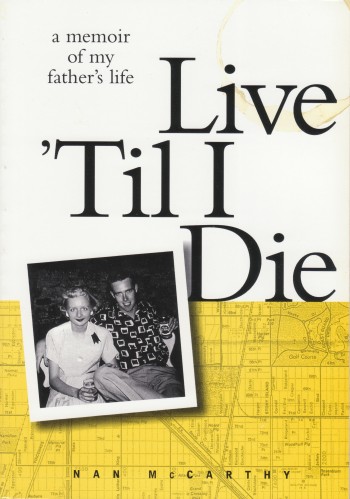
1 Live ‘Til I Die: a memoir of my father’s life

  • December 6, 2001
  • by Nan McCarthy
  • · biography/memoir · Blog · Books · Live ’Til I Die · Titles

Live ’Til I Die: a memoir of my father’s life
Nan McCarthy
(Rainwater Press, 2001) 246 pages, $14.95

In its opening pages, the final days of 39-year old Ben “Buddy” Johnson’s life are chronicled in excruciating detail through the eyes of ICU nurse Maggie Quinn. Here is the story of an alcoholic who doesn’t come out the other side—a brilliant, charismatic young man who comes of age on Chicago’s South Side in the 1940s and ‘50s, rises to prominence in his career as a trade-show executive at the Chicago Amphitheatre and McCormick Place in the 1960s, and dies horrifically of alcoholic cirrhosis in 1971, leaving a wife and two young daughters.

Thirty years later his youngest daughter sorts through the pieces of her father’s life by interviewing his boyhood friends. Through their alternately humorous and heart-wrenching stories, she learns about the man her father was before his mind and body were overcome by alcoholism. At once harrowing and hopeful, Live ‘Til I Die confronts the physical and emotional devastation wrought by chronic alcohol abuse—yet manages to offer up love, laughter, and tears while allowing a daughter to restore the memory of a father she barely knew.

“Studs Lonigan meets The Liar’s Club”

“Charts new territory in the field of addiction memoirs”

Click here for purchase information for Live ’Til I Die.

Enter your email address to subscribe to this blog and receive notifications of new posts by email.

  • Tweet
  • Email a link to a friend (Opens in new window) Email
  • Share on Tumblr
  • Share on Reddit (Opens in new window) Reddit
Like Loading...

Website Powered by WordPress.com.

  • Amazon
  • iTunes
  • Twitter
  • Facebook
  • Subscribe Subscribed
    • Nan McCarthy
    • Join 129 other subscribers
    • Already have a WordPress.com account? Log in now.
    • Nan McCarthy
    • Subscribe Subscribed
    • Sign up
    • Log in
    • Report this content
    • View site in Reader
    • Manage subscriptions
    • Collapse this bar
 

Loading Comments...
 

    %d