A lot of people ask writers where we get our ideas. Here’s how I came to write my latest novel, Since You Went Away.
Nan McCarthy
In 2008, my husband was on a year-long deployment to Iraq. Staying home on a Friday night, I happened upon a 1944 film on Turner Classic Movies called Since You Went Away. Produced by David O. Selznick and starring Claudette Colbert, it’s about a mom and two daughters fending for themselves on the homefront while the dad is off serving in World War II. The film is at once poignant, lighthearted, and somber. I immediately fell in love with the story.
Further research led me to the 1943 novel (of the same name) by Margaret Buell Wilder, on which the movie is based. Discovering Wilder had written the book in epistolary form (one of my favorite genres), I couldn’t help but fall even more in love with the story.
My first thought was, why has no one updated this story for modern times? Since You Went Away is an unusual kind of war movie in that it focuses completely on what’s happening with the family back at home. You could say it’s a war story without the war. I loved the idea of creating a modern-day story that gives readers an intimate glimpse of contemporary military family life in a way that’s accessible and—above all—entertaining. That’s what I set about doing when I started writing the four-part series in 2012.
(The entire quartet of the Since You Went Away series is now available via the links below and wherever books are sold.)
Click CreateSpace to order Nan McCarthy’s Since You Went Away (Part One: Winter) in paperback.
Click one of these to order Nan McCarthy’s Since You Went Away (Part One: Winter) in ebook.
Since You Went Away, Part One: Winter
Nan McCarthy
(Rainwater Press, 2017) 172 pages
F I C T I O N
Set against the backdrop of the Iraq war in the year 2008, Since You Went Away portrays in intimate detail the effects of a distant war on the families and returning veterans at home. With an undercurrent of suspense, it is a fly-on-the-wall account of the innermost workings of a military family—their fears and hopes, their struggles and disappointments, their unexpected moments of joy and comfort and laughter.
When her husband Liam leaves on a year-long deployment, Emilie Mahoney strives to be a source of strength for Liam and their two sons. Yet she doesn’t always succeed. Holding down a full-time job, raising two teenage boys, and running a household with a menagerie of pets—all while hosting an Iraqi combat interpreter who comes to live with them as he acclimates to life in the U.S.—Emilie frequently finds herself retreating to her bedroom with a Party Size bag of Lay’s to watch back-to-back episodes of Snapped.
Featuring a deeply human cast of characters ranging from Wade Miller, a charming, charismatic retired Marine officer who watches over the family in Liam’s absence as he struggles with secrets of his own, and the amiable, enigmatic combat interpreter Fakhir al-Azzawi who worries about the safety of his family back in Baghdad as he comes to terms with trauma from his past, to the wacky and bothersome neighbor Agnes Hawkins who always manages to say the wrong thing and whose favorite pastime is watching the goings-on at the Mahoney house from her living-room window, Since You Went Away is at once darkly funny, poignant, and un-put-downable.
This is Part One of a novel that will be released in four parts.
C O M I N G S O O N: Part Two: Spring.
about the author:
Nan McCarthy is the author of Chat, Connect, and Crash, Live ‘Til I Die, and Quark Design. The Chat, Connect& Crash series, originally self-published, was released in trade paperback by Simon & Schuster in 1998 and has been widely translated. Nan regained the rights to the series and published new editions in 2014. A former magazine editor & technology writer, Nan founded Rainwater Press in 1992 and began selling her books online in 1995. Nan and her husband, a veteran who served 29 years in the Marine Corps, are the proud parents of two adult sons. Nan wrote Since You Went Away after taking a ten-year break from full-time writing to care for the family during her husband’s frequent military travels.
In memory of my dad Ben Johnson (1931-1971), who died 46 years ago this January 15th.
Nan McCarthy
(This piece is from the collection Recipes for My Sons: Instructions on Cooking & Life by Nan McCarthy—a work-in-progress of letters to my sons about family, life, and food.)
I don’t have many memories of my dad (your Papa) since he died when I was a kid. So when it comes to the memories I do have, I tend to hold onto them. Unfortunately a lot of those memories aren’t too warm and fuzzy, seeing that Papa was severely alcoholic in the years leading up to his death a few months after my 9th birthday. But there were good memories. And even some of the not-so-good memories are kind of funny now that Aunt Gerarda and I can recall them from a safe distance.
Most of my good memories are fleeting—moments in time that skate across my mind without much context. Like when my dad let me stand on his feet while he walked around the room taking exaggerated steps, holding my hands as I giggled and tried to hang on. Papa was 6’ 4”—tall and lanky—and I was a runt (according to him). He seemed like a giant to me.
Then there were the times he’d lie on the floor on his stomach and let us kids walk up and down his back. I thought he was letting us do it solely for the fun of it, but I later learned Papa was plagued with back problems and letting us walk on his back helped him feel better.
Speaking of my dad’s back, Papa was a big nap-taker. (Nana was too, which might explain Coleman’s penchant for napping.) I remember the time my dad was asleep on the family room couch, face down, shirt off, and one of my friends and I decided to play connect-the-dots on his back, using a marker to draw lines from freckle to freckle. (I’m pretty sure we got the idea from an episode of The Dick Van Dyke Show. One can’t help but wonder how many other kids across America got the same idea?) Papa had a lot of freckles, providing us plenty of entertainment. I don’t remember how long he slept or what happened after he woke up. Maybe I blocked it out, because Papa could get pretty mad about things. If he yelled at us about it, we certainly wouldn’t have given him any back talk. (Get it? Back talk?)
If we were being punished for something when we were little, Nana usually made us sit in a chair facing a corner in the dining room. But Papa used a belt or a rolled-up newspaper on our behinds. Seeing him take off his belt when he was angry was not a good sign. I preferred the belt to the newspaper though. The belt hurt like hell, but with the newspaper we’d have to drop our pants so he could swat our bare butts. It didn’t hurt much but it was humiliating.
My dad was an imposing figure and I admit to being afraid of him at times. He kept a 20-gauge shotgun along with a bullwhip in the family room closet. (Yeah, you heard that right. Bullwhip. In the family room closet.) I saw these items every time I needed to wear a coat or use the vacuum cleaner—in other words, at least once a week if not daily. (The family room closet is also where my mom stashed her well-worn copy of Xaviera Hollander’s The Happy Hooker. It was supposedly hidden on the back of the top shelf underneath a pile of telephone books. But I found it when I was 11 or 12. Back then I eagerly awaited the nights Nana was working the floor at the Jerry Pals Real Estate office so I could return to Xaviera’s scandalous stories of life as a madam.)
Papa said he had the shotgun for shooting rabbits but there were plenty of rabbits in our yard and none of them were dead. (Speaking of the yard ask Aunt Gerarda about the time Papa was halfway through mowing the front lawn when he decided he was feeling a bit sleepy. On this particular summer day in the late 1960s, Papa turned off the mower and laid himself down in the grass for a nice long a nap. See, I told you our family likes to take naps.)
When my dad died in January of 1971, my mom gave the shotgun to his best friend, Uncle Ed Morrissey. I never saw that gun again until about 30 years later. I had recently finished writing the book about my dad, Live ’Til I Die, when the four of us traveled to Indiana to visit Uncle Ed and his wife Rosemary.
I hadn’t seen Uncle Ed since Aunt Gerarda and Uncle Dave’s wedding in 1980. During the rather lively after-party at Nana’s house, Gerarda and I noticed at one point Uncle Ed had disappeared. We ran outside into the late summer night and caught up with Uncle Ed, who was walking quickly to his car in an attempt to make an Irish Exit. (Uncle Ed and my dad were masters of the Irish Exit, a means of departure I find highly preferable to the hours-long goodbyes Dad and his side of the family seem to enjoy.)
Back to our visit with Uncle Ed and Rosemary in 2001 or thereabouts. We were sitting in the front room when Uncle Ed went into a back bedroom and came out with the shotgun. “Do you remember this?” he asked. The gun was still in its red and black leather case, exactly as I remembered it. Without even unzipping it, I could clearly picture the red fleece lining patterned with rustic drawings of hunters and various game birds (no rabbits though). “Oh yes, I remember this,” I told him. He placed the gun in my hands. “Here. You take it. It’s yours.”
My dad also owned a couple of handguns which he stored on the top shelf of my parents’ bedroom closet. (One can’t help but wonder why the shotgun and the bullwhip and The Happy Hooker weren’t also stored in the bedroom closet?) Unlike the shotgun, however, after my dad’s death my mom hung onto the handguns. That is until they were stolen in 1978, when I was a teenager. The robbery occurred two days after (and was no doubt related to) an epic party that had taken place at our house in South Holland. This unauthorized event (Nana and my step-father were on vacation at the time) involved approximately 200 or so of my closest high school friends along with a biker gang I hadn’t invited but who showed up anyway after they saw the cars up and down the block and people streaming in and out of the house. (Think Risky Business, except it’s the South Side of Chicago not the North Side, the Tom Cruise character is a girl, and instead of button-downs and Ray Bans the partygoers are wearing bell bottoms and puka shells.)
I have no idea whatever happened to my dad’s bullwhip. What a strange item to have in one’s family room closet growing up. I wish Nana was still here so she could tell us more about that. My guess (and Aunt Gerarda concurs) is that he most likely got it from someone he knew at the stockyards or while working one of the livestock exhibitions at the Amphitheater, which was next door to the stockyards.
As I’ve mentioned innumerable times, my dad had a very successful career—first as the assistant manager of the Amphitheater on Halsted Street and later as the director of special events at McCormick Place on Lake Shore Drive. In fact some of my best memories of my dad are of going to the various trade shows he ran at McCormick Place like the auto show, the boat show, the sportsman’s show, the housewares show, and the electronics show. I also have fond memories of going to his events at the Amphitheater like the flower show and the dog show.
Best of all were the times he took us to the rodeo and the circus at the Amphitheater. These memories are special because he would sit with us at the rodeo and the circus (if not for the entire show, at least part of it). Normally, at his other shows, we’d be with Nana while he ran around behind the scenes doing work stuff.
Speaking of shows at the Amphitheater, I am interminably jealous of Aunt Gerarda who was “there” when Nana saw Elvis Presley in concert. It was March of 1957—the first concert where Elvis wore the legendary gold lamé suit—and Nana was seated near the front with her parents (my Nana and Papa) while my dad worked backstage. In spite of the fact that she was six months pregnant with Gerarda, Nana stood on her chair the entire concert, along with 12,000 other screaming fans. Seeing as I am Elvis’s Number One Fan, it would have made a much better story if it was me inside my mom’s tummy that night instead of my sister, who I am sure doesn’t even like Elvis all that much.
Getting back to my dad’s career, he worked long hours, late nights, and since most of the shows went on weekends, he often worked Saturdays and Sundays too. Plus he traveled extensively on business. After his alcoholism started to get the better of him, he was in the hospital for long stretches of time the year or two before he died. Which is to say he wasn’t around very much in the nine short years I had with him.
One of the more indelible memories I have of my dad is the time he made creamed chipped beef on toast, aka Shit On a Shingle, for Aunt Gerarda and me. Nana was out somewhere and Papa was in charge of us that night—a highly unusual occurrence. That he cooked dinner for us made it even more memorable.
Shit On a Shingle, Papa-style
Melt 2 Tbsp. butter in a saucepan over low heat. Oh hell, just turn up the heat to medium because Papa was impatient like that. While butter is melting pour yourself a cup of coffee leftover from this morning. It’s going to be a long night taking care of the girls; caffeine will help. On second thought make that half a cup of coffee and fill the rest of the cup with whiskey. Eleven-year old Gerarda has the chicken pox and she is not a happy camper.
When the butter is melted (whoopsie daisy, it’s a little on the burnt side), whisk in 2 Tbsp. flour to form a roux. As you’re standing at the stove making the roux (or trying to at least), the youngest curtain-climber (age 7, aka Nancy) is tugging at your pant leg asking if she can stand on your feet. That was all fun and games a few weeks ago but you have serious business to take care of. You tell the runt to go get herself a bottle of Coke from the garage even though Dorothy said the kids have already had their ration of one teeny-tiny glass of Coke per day. I can drink the entire bottle myself? she asks. Hell yeah. Get your sister a bottle too. She’s getting a little whiny about those damn chicken pox.
Whisk in 1½ cups warm milk. Forgot to warm the milk? It’s okay, dump it in there anyway. Oh, you’re supposed to add the milk gradually, a little at a time? No problem! Everybody loves lumpy Shit On a Shingle, right? Maybe a little whiskey will help smooth it out. If not, a little more whiskey in the coffee couldn’t hurt either.
Turn up heat on stove to medium. Oh yeah, it already is on medium. Crank that sucker up to high then. The runt is back by your side, holding a bottle of Coke in one hand and tugging at your pant leg with the other. Daddy, she says, Gerarda isn’t feeling so good. You glance behind you to see Gerarda sitting at the kitchen table, looking a little green, her bottle of Coke half-empty. You drank your damn Coke too fast! you tell her. No I didn’t, she says. I don’t feel good because I have the chicken pox!
You turn back to the stove. Were you supposed to be stirring the roux this whole time? Nevermind. Just scrape those brown bits from the bottom of the pan and mix them in with the roux, which is more like a glob at this point.
Runt is tugging at your pant leg again. Daddy, she says, Gerarda’s crying. What? You turn around to look at your oldest, who is in fact crying. Jesus H. Christ Gerarda! you say. How many times have I told you… Laugh and the world laughs with you; cry and you cry alone.
This overly familiar pep talk only causes Gerarda to cry harder. Daddy, I don’t feel good! Here, you say, grabbing her half-empty Coke bottle and filling it with whiskey. Drink this. It’ll make you feel better. All of it? she asks. Yes. All of it.
While Gerarda attempts to chug her very first Whiskey and Coke at age 11—making retching noises behind you as she does so—try to focus on chopping 8 oz. dried beef (made right down the street at the Carl Buddig factory) and add it to the roux.
Daddy! This drink tastes terrible! Gerarda cries. Just finish it, you say without turning around. At this point take another swig of your “coffee” and proceed to add a shit ton—and I mean a SHIT TON—of pepper to the saucepan, until the entire mixture has become grayish in color. (In other words, until it looks completely unappetizing.)
Meanwhile, ignoring the runt tugging at your pant leg and the gagging noises Gerarda is making at the table, pop a couple pieces of bread in the toaster and when it comes up tell the runt to butter it while you put in two more pieces of bread. Now you hear whimpering and sniffling behind you but you refuse to turn around because there’s two more pieces of toast to be buttered and you’ve got shit to do.
Place a piece of toast on each of two plates for the girls, then place two pieces of toast on your own plate. Grab the saucepan and evenly distribute the lumpy, grayish gobs onto each piece of toast. Voila! You have now made Shit On a Shingle. Tell the runt to grab a plate and sit down. Holding your plate in one hand and Gerarda’s in the other, you finally turn around, only to find Gerarda, head resting on the kitchen table, completely passed out.
***
It’s hard to lose a parent at any age. No matter how old we are, a parent’s death affects us deeply and profoundly. Yet there’s something singular about losing a parent in the formative years, when our brains are at their most malleable. From that point forward, every moment in one’s life is experienced through the lens of loss. It shapes who we become, the career paths we take, the partners we choose, how we raise our children, our willingness to take risks and live life to the fullest. Because we know at any moment it can all be taken away from us. For better or worse, the parent we lost at an early age remains a compelling presence throughout the rest of our lives, reminding us that life is hard, life is unfair, life is transient.
The Saturday my dad took Aunt Gerarda and me on a spur-of-the-moment excursion to the Shedd Aquarium stands out in my mind as one of the more carefree memories I have of him. I don’t remember many of the specifics of that day. (Other than the fact that Nana was still asleep when we left the house and Papa didn’t leave her a note. And yeah, she was pretty pissed with him by the time we strolled through the door that night.) But I do remember the giddy excitement of being on an adventure with my dad.
In the many times I’ve returned to the Shedd since then—on school field trips, with friends, and later with all four of us when you kids were little—my feelings from that day have stayed with me. When I walk through the galleries of the original wings of the Shedd, marveling at the beautiful sea creatures from all over the world, what I remember most about that day with my father is the feeling of being loved. I didn’t really know that’s what it was at the time, but now that I’m a parent I understand. When a parent takes a child on an excursion to the zoo or the park or a ballgame or a museum, it’s not really about the destination. It’s what the parent is telling you by taking you on that adventure: “I love you. I care about you. And I want there to be more happy times in your life than sad times.”
I can’t say for sure if that’s what my dad had in his heart that day. If all he wanted was to go see the fish at the aquarium, he certainly could have gone without us, seeing as he left us in the dust more often than not. But something made him choose to take us with him that day. Somewhere deep inside him, he wanted to be a good parent.
Gerarda, Nancy, Dorothy, Ben on Nancy’s 9th birthday in October 1970. Ben died less than three months later.
In honor of my father in-law Bob McCarthy (1930-2007), whose birthday is today.
Nan McCarthy
(This piece is from the collection Recipes for My Sons: Instructions on Cooking & Life by Nan McCarthy—a work-in-progress of letters to my sons about family, life, and food.)
When Grandpa Bob was alive and the McCarthy siblings entered adulthood, it became something of a tradition for the sons to take Grandpa on a golf outing for Father’s Day. These outings typically involved Uncle Chris, Uncle Steve, Uncle Tom, your dad, Uncle Larry, Uncle Emmett, Aunt Sue’s husband Donn, and Uncle Steve’s oldest son, your cousin Ian.
Eventually the Father’s Day golf outings in June were replaced by a night on the town to celebrate Grandpa’s birthday at the end of November. After Grandma Caryl died and Grandpa formed a new blended family with Grandma Pat, Grandma Pat’s sons also sometimes joined the get-togethers.
The evening would kick off with a nice dinner at a place like The Rosebud on Taylor Street or Fogo de Chao on North LaSalle. Dinner would be followed by a few stops at nearby bars before calling it a night. As you can imagine, when six Irish brothers hit the town with their Irish dad, raucousness generally ensues. Rumor has it the particular level of rowdiness correlated directly with the amount of alcohol consumed—mostly beer and Irish whiskey, from what I hear. (Unless the birthday dinner happens to be at Cuernavaca in Pilsen, where your dad swears he and his brothers invented the idea of mixing rum with Horchata, years before RumChata became a thing. Ben, I think you might have been in attendance on this particular night since you were living in Pilsen at the time.)
Speaking of beer and whiskey, one of Grandpa’s favorite drinks was a “shot and a beer,” also known as a boilermaker.
How To Drink a Shot and a Beer, Grandpa-style
Walk in the door to the house in South Holland and loosen your tie after a long day doing engineering stuff at the Sanitary District of Chicago—now known as the Metropolitan Water Reclamation District of Greater Chicago.
(By the way, Coleman, you and several of your cousins most likely inherited your enginerd tendencies from Grandpa. As a Marine option in the Naval ROTC program at Marquette University in Milwaukee (where he and Grandma Caryl met), Grandpa earned his degree in civil engineering and was commissioned as a second lieutenant in the Marine Corps. During the Korean War he served as a combat engineer for 1st Combat Engineer Battalion, 1st Marine Division, where, according to Grandpa, he and his fellow engineers dedicated themselves to building bridges, blowing up bridges, and then again building more bridges. After he got out of the Marine Corps Grandpa spent the remainder of his career at the Sanitary District, working on projects like Deep Tunnel, the largest public works project in Chicago history.)
Back to Grandpa’s shot and a beer. Go upstairs and change out of your business attire into something more comfortable, preferably a tattered shirt from the 1960s you refuse to get rid of and a pair of trousers that are even older than the shirt (probably mid-Century), which Grandma Caryl has mended at least 80 times. (There are plenty of new clothes in the closet but Grandpa prefers wearing the old stuff. Hmmmm, that sure sounds familiar, doesn’t it?)
Enter the kitchen and say hello to Grandma Caryl, who’s standing at the stove making something delicious yet cost-conscious like meatloaf or split pea soup or chili mac (they did have seven kids to feed after all). Sit down at the kitchen table where your boilermaker is already poured and waiting for you: A shot of whiskey—sometimes Jim Beam but usually Kessler (or Kesslers as we say in Chicago)—and an ice-cold glass of either Carling Black Label (or Carlings, see above), Weidemann’s, or Stroh’s. (These last two beers really do end in “s,” no South Side dialect required.)
Some people mix the whiskey with the beer, but Grandpa drank his boilermaker the old-fashioned way: Down the shot in one swig and follow it up with the beer as a chaser—usually sipped, but in Grandpa’s case, more likely guzzled. In the rare event Grandpa sipped rather than guzzled his beer, Grandma Caryl might ask him for a schluck (pronounced “schlook”), which means “sip” in German. At Grandma and Grandpa’s house, “schluck” held a particular meaning, which you guys (or should I say yous guys?) already know, since Dad and I use “schluck” the same way: A schluck is bigger than a sip but smaller than a gulp. Neither dainty nor greedy, a schluck falls somewhere in the middle—a perfect way to nab a taste of someone’s else’s beer.
***
While his appreciation for a good whiskey and glass of beer (or two or six) may have caused the family a certain amount of angst in earlier days, by the time you two were born Grandpa had grown into himself as a loving and dedicated husband, father, and grandfather. When Grandma Caryl was diagnosed with a rare and deadly melanoma, Grandpa stepped up to the plate like a boss, transporting Grandma back and forth to the hospital for her treatments and taking over the cooking and cleaning—all while still working his full-time job at the Sanitary District and being a parent to Uncle Emmett, the youngest of the McCarthy siblings still living at home.
After Grandma Caryl died and Grandpa was lucky enough to fall in love with and marry Grandma Pat a few years later, his dedication to his kids and grandkids became even more apparent. When he wasn’t calling on the phone or visiting everyone in person, he’d mail newspaper articles to each of his seven children, their spouses, and you kids—always with a note saying, “This reminded me of you.” Grandpa was the original email forwarder, except his links were actual newspaper clippings, his notes written by hand, the articles folded into a real envelope with a stamp, and sent through the mail.
I’m glad Grandpa was alive long enough that you two could get to know him. I know you felt his love when he and Grandma Pat took you downtown to go ice skating in Millenium Park or to see the Sue exhibit when it opened at the Field Museum in 2000. Or when you spent the weekend at their townhouse in Orland Park and they took you to play mini-golf at White Mountain and to the Plush Horse afterward for ice cream. (Speaking of ice cream, Coleman, I know you especially loved it when Grandpa ate all your chocolate mousse after dinner one night at the Berghoff. Ha!) Or how about when they flew hundreds of miles to visit us in Fredericksburg, Virginia (remember our adventure to Thomas Jefferson’s Monticello, eating grapes right off the vine?) or when they drove to Kansas City for Dad’s Marine Corps promotion and celebration dinner at Starker’s Reserve on the Plaza, where Grandpa could barely contain his pride.
As far as fathers in-law are concerned, I won the jackpot. Even before your dad and I were married Grandpa treated me like I was someone special, picking up Fannie May Mint Meltaways on his way home from work to give to me for my birthday because he knew they were my favorite.
Grandpa was incredibly supportive of my career. He bought copies of my books to give to family and friends, and came to every one of my book signings and trade shows within driving distance. During our frequent phone conversations he never failed to ask me how my writing was going. And you knew he wasn’t just asking to be polite—Grandpa was the type of person who really listened to what you said and remembered every detail the next time you talked.
I learned a lot from watching Grandpa interact with family. He was proud of every single one of his kids and grandkids, and rarely spoke a negative word about anybody. When he married Grandma Pat he embraced her children as if they were his own, and it meant so much to him (and Grandma) when the two families came together for holidays and special events.
Grandpa was frugal to a fault. He had a hard time getting rid of anything. (Hmmm, that sounds kinda familiar too.) When he was moving out of the house in South Holland after Grandma Caryl died, he couldn’t bear to throw stuff away, but he was okay with giving it to us kids. So when the four of us stopped at the house to visit, Grandpa wouldn’t let us leave without a trunk full of boxes. Boxes of old papers, canned goods that had expired ten years ago, and random pieces of junk from the garage. Dad and I learned to accept the boxes with a smile. Then we’d stop at a dumpster on the way home, sort through everything, save anything sentimental or useable, and throw away the rest. (Sorry Grandpa, it was our little secret.)
When Grandma and Grandpa stayed in hotels, Grandpa always collected the paper cups, coffee stirrers, sugar packets, and napkins to give to us. Like father like son, your dad considered these items extremely useful and we ended up accumulating an entire drawer full of Grandpa’s hotel “gifts.” It became a running joke to the point that one year on vacation I collected all the cups, stirrers, sugar packets, and napkins from every hotel we stayed at, wrapped them in fancy paper, and sent them to Bob for his birthday. Grandpa was always one to appreciate a good prank, and this was no exception.
When we traveled back to Chicago in 2000 for Grandpa’s 70th birthday party at Uncle Steve and Aunt Christine’s house, Grandpa gave a heartfelt, tearful speech expressing his gratitude and reminiscing about his life. He shared his memories of growing up during the Depression. He talked about picking up pieces of thread off the street to bring home to his mother so she could use them for mending their old, worn-out clothes because they couldn’t afford to buy new clothes. When he told us about his schoolmates teasing him for his threadbare, ill-fitting outfits, Grandpa cried into his handkerchief. Watching him blow his nose and wipe his tears away, I realized we’d been given a glimpse of the little boy Grandpa held inside his heart all those years.
Another of my favorite memories of Grandpa was when the McCarthys gathered at Uncle Tom and Aunt Martha’s house for Father’s Day 2007. Almost all the family was there, including Grandma and Grandpa and most of your aunts, uncles, and cousins. The 17-year cicadas were out in full force (the last time being the summer of 1990, not long after Ben was born). Our eardrums vibrated from the non-stop buzzing while the ground, littered with cicada carcasses, crunched beneath our feet.
I don’t remember what was on the menu that day, but I do remember (as I’m sure you do too), one of the McCarthy brothers (I don’t remember who) getting the brainy idea to toss a few dead cicadas on the grill to “see what they taste like.” In short order a “few” cicadas became many, and eventually the brothers began seasoning the cicadas with hot sauce or marinating them in whiskey before grilling, resulting in a rather unique dining experience. As I recall, most of the McCarthys in attendance sampled at least one grilled cicada, including Grandpa.
By that time Grandpa’s prostate cancer, which had remained in check the previous ten or fifteen years, had taken its toll. The numerous treatments he underwent in recent years were no longer working. He suffered from neuropathy and was in a great deal of pain. But that’s another thing about Grandpa—he rarely complained, preferring to talk about other people rather than himself. I think everyone understood the seriousness of Grandpa’s health issues but on that day he didn’t seem so bad. He and Grandma sat on Tom and Martha’s screened-in porch, Grandpa on the wicker couch with his feet up, pillows propped under his legs to ease the pain. He was sharp as ever (if not thinner), clearly reveling in the shenanigans going on around him. When offered a grilled cicada to sample, Grandpa didn’t hesitate to pop one in his mouth.
Because of Dad’s career in the Marine Corps, more often than not, we have lived far away from family. But whenever we could, we made the drive from Quantico or Denver or Fredericksburg or Kansas City to spend time with those we loved. And how thankful we were to have made the nine-hour drive to be with Grandpa on that Father’s Day. He died in his sleep less than two weeks later on June 30, 2007.
Grandpa’s been gone for almost ten years now but the brothers still get together to celebrate his birthday. Some years it’s challenging to find a date that works for everyone. But most years everyone makes it. This year has been a little more hectic than usual around our house, and the timing of the get-together isn’t ideal. When he heard the date for this year’s gathering, your dad expressed concern about leaving me to deal with various responsibilities on my own. I knew if I said I needed him here, he’d stay home with me in a heartbeat, because that’s the kind of husband he is. Your dad is who he is in part because of Grandpa. “You have to go,” I told him. “I’ll be fine.” Here’s to you, Bob. A shot and a beer in your honor.
Kneeling: Grandpa Bob. Standing: Tom, Donn, Steve, Emmett, Chris, Pat, Larry, Ian.
Occasionally I receive inquiries from students who’ve been assigned the unfortunate task of keeping a dialectical journal or writing a paper on one of my books. I love chatting with students and I always make an attempt to answer student emails when time allows. Here’s an interview with a high school student in Chicago who read Live ’Til I Die for her AP English class.
Nan McCarthy
Student: I wanted to know a little more about the last section of every chapter. From what I can tell it looks like a switch from the actual memoir to an update of the present day. Was the intention of adding these parts in the book more for the reader or for yourself? I personally liked reading the process that you went through trying to bring this book together.
Nan: Yes—the first-person interludes at the end of each chapter are updates from the present day (“present day” being the two-year period in which I wrote the book, 2000-2001). Although my main purpose in writing Live ’Til I Die was to tell my father’s story, the secondary story (intertwined with my father’s story) was my attempt to put the pieces of his life together and therefore gain a better of understanding of who he was. With this perspective in mind you can’t really have one without the other. If it was just a straight-up account of my father’s life it would have been a biography. That’s why the book is subtitled “a memoir of my father’s life”—because by using the term “memoir,” it’s understood that the telling of his story comes from a very personal place, colored by my relationship with him as his daughter as well as by his relationships with his friends.
Student: Reading your book was nothing like anything I have ever read. I enjoyed the format in which the stories were told and how you had each chapter in chronological order. Not that I had a problem with it, but were there any times in which you felt as though the stories overlapped too much and it seemed repetitive? Was this on purpose to emphasize that certain events actually happened?
Nan: The way the various voices were arranged and edited was extremely purposeful. I had hours upon hours of tape recordings of interviews with each person who knew my father. I transcribed these recordings verbatim, then printed out the transcriptions and made comparisons between and among the various viewpoints, finding patterns and common themes as well as discrepancies. As the story of my father’s life began to take shape through the cumulative telling of each person’s story, my goal was to accurately convey the key events and emotions presented by each person.
I never doubted the veracity of the events as they were described to me so no, the repetition was not meant as a means of corroboration—although by their very nature those shared recollections did ultimately serve as a sort of corroboration. And while many of the interviewees talked about the same events, the fact that each person’s recounting of that event came out slightly different was fascinating to me. People have different memories of shared events because we each recall and interpret a particular event based on our various life experiences, personalities, and world views. With that in mind I find it remarkable that the stories my dad’s friends told me were as similar as they were. I believe those similar perspectives are a result of my dad’s friends’ shared upbringing and cultural backgrounds in a very specific place (Chicago’s South Side) at a unique moment in time (1940s, ’50s, and ’60s).
Student: You clearly state that your goal “from the start was to explore a world beyond [your] own memories of [your] father, to get to know him through the eyes of his peers” (231), which is what you did. I cannot even imagine how much work that might have been! I bet it was such a rewarding experience for you to see all of it come to together in the end.
I know you must be super busy so I’ll try to keep this short. I would love to know more about your use of rhetorical devices. Specifically speaking, when Maggie Quinn said, “Of course, it was tempting to want to ask such patients, ‘How could you do this to yourself?’ and to ask the family, ‘Why did you let it get to this point?’’ (11), was this an appeal to pathos? If you could direct me to a few more examples that would be great.
Nan: I appreciate the citations! Yes, writing Live ’Til I Die was an incredibly rewarding and satisfying experience. It was also surprisingly uplifting. A lot of people might think writing a book about my father dying so tragically at such a young age would be depressing but it really wasn’t like that for me. Of course I am always sad at the loss of him, but the experience provided me with a sense of compassion for my dad that I didn’t have before I wrote the book—and coming from a place of compassion is always uplifting.
Re: rhetorical devices and pathos. I don’t think much about literary devices when I’m writing (and I’d venture to say it’s the same for most writers). Although it helps to have knowledge and understanding of such devices, when it gets down to the actual writing of a novel (or memoir, in this case) I’m going by instinct, trying to find the words and sentences that will most accurately and efficiently convey a particular scenario, emotion, or thought. When I’m writing I’m not thinking “Oh, a rhetorical device or an appeal to pathos would work well here.” That’s not to say that an after-action study of a particular work is pointless. As a student of literature it’s necessary for your understanding of the writing process and of the work itself to break it down and understand the various devices being used. But as a writer I’m not consciously thinking of anything but putting words and sentences together in a way that best expresses what’s happening in my head.
What I do consciously think about is the rhythm of the words I’m writing, which is why I often read my work aloud as I’m working. If I verbally stumble over a word or phrase, it’s a sure sign it needs to be written more efficiently. The other thing I’m conscious of when writing is using my words in the sparest way possible. I’m always searching for the simplest, most direct way to evoke whatever is going on in my brain. This is more a matter of style and the way I like to write; other writers take different approaches and that’s what makes it fun to read books by a variety of authors.
With that in mind I don’t think I could provide you with specific examples of particular literary devices in my own work because I haven’t studied my work from that perspective. Everything that’s there was written instinctively and whatever literary devices I may have used were entirely subconscious. Having said that, if you’d like to ask me about particular passages I am happy to explain my thought process at the time of writing each scene.
Regarding the specific example you mentioned where nurse Maggie Quinn says it’s tempting to ask how an alcoholic can do this to himself or how a family can let it [alcoholism] get to that point, these are common themes and questions that often come up among people who haven’t personally experienced addiction (either within themselves or with a loved one). I felt these questions in particular were important to reference because it’s natural to wonder how a person like my dad, who appeared to have everything—intelligence, good looks, successful career, loyal friends and a loving family—could throw it all away because of an addiction. This is really one of the key questions in the book and by having the nurse frame these issues right up front it’s setting the tone for everything that follows.
One of the main reasons I used the nurse’s perspective to bookend my father’s story is that I wanted to showcase the physical effects of alcohol addiction. Most addiction memoirs focus on the social and emotional fallout of addiction (losing a job, losing friends, divorce, legal trouble, etc.) but I don’t know of any other (non-medical) book that goes into such detail about what alcohol addiction does to a person’s body physiologically. This is why I took the time to interview a real-life ICU nurse who had experience treating alcoholic patients. Understanding the absolute horror of how a person’s organs deteriorate due to prolonged alcohol abuse really speaks to the power addiction has over a person and helps answer the questions mentioned above.
So to answer your question, no, it wasn’t an appeal to pathos so much as acknowledging a very basic, universal, philosophical question behind our desire to understand how a person becomes an addict, why it’s so difficult to overcome addiction, and why some people are able to recover while others aren’t. The second question (how can family members let it get to this point) acknowledges the genuine helplessness family members experience as they witness a loved one being destroyed by an addiction. The interviews with my dad’s family and friends that follow the prologue illustrate perfectly how one can witness someone crossing over to addiction and not even realize it, then being absolutely powerless to change the course of events once the addiction has taken hold of a person.
Student: And lastly this is more of a ‘thank you’ than anything. I appreciate that you added pictures of your family and of your father’s friends. I used it as reference when I was reading and it was nice to have a face with most names.
Nan: Thank you—I’m glad you enjoyed the photos. They are a treasure to me.
Roger Laven, Bill Caho, Ben Johnson, Dick Crimmins, Al Young
In honor of my mom, who died 14 years ago yesterday.
Nan McCarthy
(This piece is from the collection Recipes for My Sons: Instructions on Cooking & Life by Nan McCarthy — a work-in-progress of letters to my sons about family, life, and food.)
My mom (or Nana, as she was known to you guys) loved to cook. Like many housewives in the 1950s, ’60s, and ’70s, she cooked dinner from scratch almost every night of the week. We rarely—if ever—ate frozen meals or fast food for dinner, even during the years Nana worked as a real estate agent to support Aunt Gerarda and me after our dad (your Papa) got sick and died. Occasionally we were allowed to order a square-cut, tavern-style pizza from Geneo’s on Halsted (and later from Aurelio’s or Barton’s) but that only happened once every couple months in those days. Mostly it was homemade meatloaf, chicken paprika, pork chops, chicken kiev, beef stroganoff, fried chicken, roast beef on Sundays, fried lake perch on Fridays, and—when she was feeling casual—tostadas, pizza burgers, chop suey, or francheezies (hotdogs split down the middle & stuffed with American cheese, wrapped in bacon, held together with toothpicks and broiled).
These were sit-down meals that almost always (exceptions being the “casual” meals mentioned above) included a meat, a starch, plus a vegetable and salad. The only time we were not expected to partake of the meal being served was when Nana cooked liver and onions, which she loved but which Aunt Gerarda and I disliked so intensely we’d start to retch as soon as the liver hit the frying pan and the putrid smell began to permeate the kitchen. On those nights Nana would let us eat something different, like an Appian Way pizza from the freezer (those being normally reserved for late-night snacking) or a grilled cheese sandwich. Aside from the smell, I came to love the nights my mom made liver and onions, knowing it was the one night we’d get a free pass at the dinner table.
Nana loved trying new recipes too, and one of my favorite memories is of her sitting at our kitchen table in South Holland, both feet perched on the edge of another chair she had pulled beside her, knees bent, a Bon Appétit magazine propped open in her lap, a plate of thick-sliced homegrown tomatoes (heavily salted of course) on the table in front of her, a kitchen towel tucked into her collar to protect her blouse from the tomato drippings. Each new issue of Bon Appétit resulted in at least four or five new creations a month from Nana’s kitchen. Unfortunately I was a picky eater as a child so I didn’t appreciate my mom’s adventurous culinary spirit—which is a shame, because as I mentioned she was an excellent cook.
One dish of Nana’s that I didn’t especially like as a child but which I’ve grown to love over time is Nana’s vegetable soup, which was one of her specialties. She made it often during the cold Chicago winters, but she also made it during other seasons if someone was sick or if a neighbor had a death in the family (it was her version of chicken soup I guess). Even when no one had died or was sick, Nana loved sharing her food creations with the neighbors, especially her vegetable soup. As a child I remember being asked to carefully transport large Tupperware containers filled with Nana’s vegetable soup across the yard or street from our house to the Finlons, Scruggs, Caputos, Petrungaros, Stotts, and others. (This is obviously where I picked up my habit of sharing food with neighbors, one that grew to epic proportions when we lived across the street from my good friend Mary Taylor, who also loved sharing her delicious cooking. It got to the point that anytime I cooked something special when we lived in Grayslake, I’d make extra to send over to the Taylors, knowing Mary was doing the same for us.)
Getting back to Nana, she became known for her vegetable soup among the neighbors, and I remember being frequently asked by my playmates’ parents if my mom would be sending any more of that vegetable soup over any time soon. Of course Nana loved the positive feedback on her cooking and it wouldn’t be long before I found myself transporting another Tupperware container of soup across the yard to said neighbor.
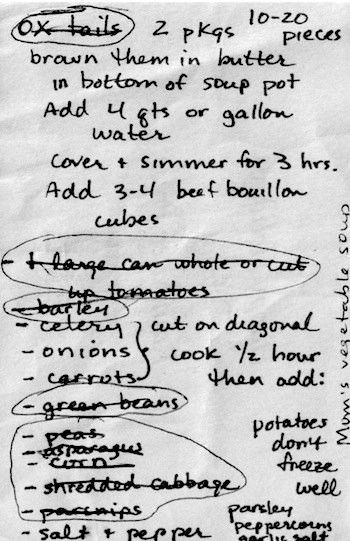
Over the years, but especially since Nana died (and especially during these cold winter months), I find myself craving her homemade vegetable soup. At one point when she was still alive I asked her for her recipe. Like a lot of good cooks with signature recipes, it was not one that she’d written down anywhere; it was just something she made from scratch off the top of her head. But I must have asked her to explain to me how she made it during a phone call, because I found a scrap of paper that I think was from the early 1990s in which I’d jotted down some notes.
Nana’s Homemade Vegetable Soup
Brown 10-20 oxtails in butter in the bottom of a large soup pot. (I actually loved the oxtails in my mom’s soup when I was a kid; now that I’m older I find them repulsive. So in place of the oxtails, these days I sauté the vegetables in 2 Tbsp. butter and 2 Tbsp. olive oil. If I’m really craving a more full-bodied meaty flavor in the soup and I don’t need to keep it strictly vegetarian or without red meat, I’ll replace the 2 Tbsp. olive oil with 2 Tbsp. bacon grease.)
To the melted butter and olive oil (or bacon grease) add sliced carrots, celery, onions, green beans, peas, corn, and asparagus (optional). My notes from Nana say to slice the veggies “on the diagonal.” Once the veggies are softened (about 7-8 minutes), add 2 quarts chicken broth. (Nana’s recipe calls for beef broth. I prefer chicken broth. You can also use vegetable broth.)
Once simmering, add one 28-oz. can crushed tomatoes. (I use Ro-Tel diced tomatoes w/ green chiles plus an extra small can of chopped green chiles, which gives the soup a nice kick that your dad likes.) Add 1 cup medium (not quick-cook) barley, a handful of shredded cabbage, parsley (I use thyme instead), peppercorns, garlic salt, salt & pepper. (I skip the garlic salt, salt & pepper since there’s enough salt in the chicken broth and Ro-Tel already. Plus you can always add more salt at the table if you want.) Nana’s notes say don’t use potatoes in the soup because they don’t freeze well and I agree, mostly because I don’t think the soup needs another starch after the barley. Add 2 Tbsp lemon juice (my addition), cover and simmer on stove three hours. Serve with warm bread and butter.
I always double this recipe—for sharing, of course.
(This piece was written in 2015 and is from the collection Recipes for My Sons: Instructions on Cooking & Life by Nan McCarthy — a work-in-progress of letters to my sons about family, life, and food.)
My sister Gerarda (Aunt Gerarda to you guys, G-Thang to her kids) is one of those people who lights up a room with her stories. She’s the perfect party guest because she’s not afraid to hold the floor for a few minutes entertaining everyone with an amusing anecdote (or two or three). You can always tell when Aunt Gerarda is about to go into storytelling mode. Her lips begin to form an almost imperceptible smile, and her big blue eyes gleam with a hint of mischief. Once she has your attention and begins speaking, she becomes fully animated, acting out the various parts of the story with a full range of facial expressions, voices, body movements, and hand gestures.
Aunt Gerarda is a natural-born storyteller. I know because I’ve witnessed her gift for telling stories as far back as I can remember, when she was eight years old and I was her four-year old little sister following her around our Chicago neighborhood. Sometimes I couldn’t actually see Aunt Gerarda entertaining family and friends when they came to the house, because I was known to run and hide under the bed every time the doorbell rang. And there I would stay, until whomever it was who had come to visit (friends, neighbors, and even some relatives I wasn’t completely familiar with) would leave. (Those who know me now would find it hard to believe I was terminally shy as a child — but more on that in a minute.)
Whether I was hiding under the bed or watching from the sidelines, I always marveled at Gerarda’s ability to be at ease in front of people. As a child she had reddish-brown hair (like our dad’s before he turned gray), a freckled nose, the aforementioned big blue eyes, and a 1,000-megawatt smile that could charm even the stodgiest adults. When our parents had parties, Gerarda often warmed up the crowd with a skit or a goofy costume or a joke before we kids were banished to the basement to play amongst ourselves, where Gerarda would continue providing entertainment.
As the years progressed, Gerarda became known as “the friendly” Johnson girl while I was viewed by some (mostly those who didn’t know me well enough to understand the extent of my introversion) as the “standoffish” one. As a youngster I was more than happy to hang in the background where I felt the most comfortable. I had an active inner life and, when I wasn’t tagging along with Gerarda and her friends, I spent a lot of time by myself, living in imaginary worlds talking to my imaginary friends. (Okay yeah, I was kind of a weirdo.)
What Gerarda may not have realized though is how much I idolized her back then (and still do today, even in our fifties). As I reached adolescence, watching my sister navigate high school, I couldn’t help but envy Gerarda’s ability to connect with people. She always had a multitude of girlfriends (still does) and could strike up a conversation with pretty much anybody — anytime, anywhere. I eventually grew tired of people’s misperceptions of me and decided I wanted to try being more open and friendly like my big sister. She was a role model for me as I cultivated my sense of who I was and how I wanted to relate to the world. With Gerarda as my guide, over the years I learned to smile more, strike up conversations with strangers, let my silly side show, and not be afraid to share a funny story on occasion. (Though I still prefer telling my stories on paper rather than in person, where writing in solitude is not unlike hiding under the bed.)
Getting back to Gerarda, her knack for storytelling has transformed itself in my mind over the years. As kids, her storytelling skills were simply a natural-born gift we all enjoyed and appreciated, but as adults, her continued ability to entertain and connect with people through her stories is a testament to her strength, courage, and determination. In 1993, when she was just 36 years old and a mom to three young kids, Aunt Gerarda was knocked flat by an intense headache and severe nausea. She, Uncle Dave, Grandma Helen, and cousins Faith, Luke, and Joy were driving back to Illinois from our house in Denver where we had been celebrating Coleman’s recent birth. After they reached home it was discovered Gerarda had a brain tumor called an acoustic neuroma. Long story short, Gerarda had brain surgery to remove the tumor followed by a long rehabilitation and recovery period. Among other things, she lost the hearing in her left ear and suffered some nerve damage which affected the facial muscles on the left side of her face.
Given such circumstances, some people might react by limiting their encounters with new people and new situations. But not my sister. After her recovery from the brain tumor, Gerarda didn’t just go back to living life the way she was — she became more of who she was. More outgoing, more friendly, more funny than ever. I like to think of who she is now as Full Metal Gerarda. She had always been one to stay busy, but after her brain tumor she embraced life with a vengeance, not only being a great mom to three young kids, a devoted wife to her supportive husband, but also working at various outside jobs, serving as president of the school board for many years, and, on top of all that, keeping the fullest social engagement calendar of anyone I know. If I happened to ask Gerarda about her plans for the weekend, it was (and still is) an extensive list of social gatherings, community events, road trips, parties, and service to others.
Speaking of service to others, Gerarda is a fabulous cook and one of the things she’s known for among friends and family is her Gooey Butter Cake, a confection that originated in St. Louis and is well-known throughout the Midwest.
Aunt Gerarda’s Gooey Butter Cake
Combine 1 box yellow cake mix with 1 stick butter. Add 1 egg, mix, and press into a buttered 9 x 13 pan. While pressing the bottom layer into the pan tell some funny stories to any number of people sure to be visiting and gathered around the kitchen. Beat 1 8-oz. pkg. cream cheese with 2 eggs, 1 lb. powdered sugar, and 1 tsp. vanilla. Pour over bottom layer. Bake 40 minutes at 325°. While cake is in the oven tell a few more funny stories, including some that allow humorous impersonations of husband Dave. (Embellishment and exaggeration always welcome. Indulging in a few cocktails tends to make the stories even funnier.) Sprinkle with more powdered sugar while hot. Serve Gooey Butter Cake at birthday parties, church functions, and all major and minor holidays. Bring Gooey Butter Cake on road trips to visit Faith, Luke, and Joy and nieces and nephews away at college.
***
Aunt Gerarda is also one of the bravest people I know, and not just because of how she overcame her brain tumor. A few years ago she stood up in front of a huge crowd in a bar in Chicago at a Moth event (“The Moth: True Stories Told Live”) to tell a story about Uncle Dave falling off the roof of their house (the theme was “falling,” and luckily Dave is fine). She’s given cooking classes at various venues in her town (the fact that she can cook, talk, teach, and be entertaining all at the same time is a feat unto itself). She’s given library presentations, radio interviews, and written stories for publication. (Gerarda’s storytelling skills span both oral and written entertainment.) I’m sure I’m forgetting many of the things Gerarda has accomplished with her stories, but you get the idea.
As sisters, our relationship hasn’t always been easy. Growing up under the circumstances that we did, each of us had to work hard over the years to shed some of the unhealthy dynamics we learned as children of alcoholics. There were times we needed to take a break from each other, to find our way in the world, to figure out who we were apart from our family history. And I’m happy to say we’ve come back from those difficult times stronger than ever. Both individually and as sisters.
And this is where I’d like to speak directly to you, Ben and Coleman. You may have times in your lives when you feel you don’t have a lot in common with each other, and staying close is more of a challenge than a pleasure. You might even have to take a breather from one another now and then. But always keep each other close in your hearts. Do your best to stay connected. No one knows you like a sibling. No one knows your history, no one watched you struggle to become the person you are today like the person who knew you growing up. And having witnessed your struggles, no one will love you and appreciate you and admire you in quite the same way a sibling does.
Gerarda was my role model growing up, and she still inspires me today. Her Gooey Butter Cake is made with love, like everything she does. And, as people who know and love Gerarda have come to expect that she’ll bring her Gooey Butter Cake wherever she goes, it’s also expected she’ll have a funny story to share. It’s who she is.
In honor of my mom, Dorothy (aka Nana), on Mother’s Day.
Nan McCarthy
(This piece is from the collection Recipes for My Sons: Instructions on Cooking & Life by Nan McCarthy—a work-in-progress of letters to my sons about family, life, and food.)
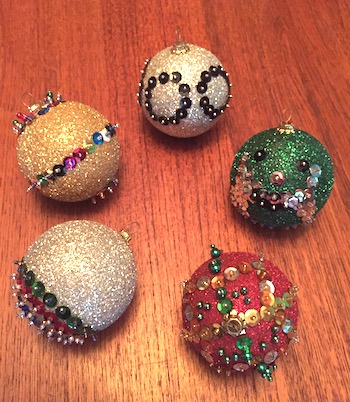
“Shit.” “Goddammit.” “Fuck it.” These generally aren’t the types of expressions one hears coming from the mouths of mothers and grandmothers — unless your mom happens to be named Dorothy (or Nana, as she was known to you grandkids). But this is exactly what we heard coming out of Nana’s mouth that wintry December day in 1999 when I got the harebrained idea to make homemade Christmas ornaments using glitter-covered Styrofoam balls, straight pins, beads, and sequins. I had found the instructions in one of those home decorating magazines and thought it would make a fun family activity while Nana was visiting us from Florida for the holidays.
You guys were nine and six years old at the time, home from school on Christmas vacation. I remember the five of us sitting around the dining room table in Grayslake (Dad, me, Nana, and you two), the craft supplies spread before us. The concept was simple: Thread a bead and a sequin onto the straight pin, insert the pin into the Styrofoam ball, and repeat until the ball was covered in beads and sequins. You could choose to wing it, making a random design using multi-colored beads and sequins, or you could plan ahead, making a pattern or image using specific uniform colors in a pre-imagined shape. Easy-peasy, right?
Of course, we all had our own ideas with specific designs in mind, and we happily set to work threading our pins with beads and sequins and pushing them into our glitter balls. As I recall, I was spelling out the year “2000” with my pins using black beads and sequins on a silver ball (because Millennium), Dad was making an artsy-fartsy vintage design with green and gold sequins on a red ball, Coleman was making an extremely neat and precise spiral pattern in reds, greens, and blues on a silver ball, Ben was creating an abstract Santa smiley face using silver and black sequins on a green ball, and Nana was attempting something flashy using multi-colored beads and sequins on a gold ball.
It didn’t take long, however, for Nana to be the first to accidentally stab herself with the pin. “Shit,” she’d mutter under breath. I’d glance sideways at Dad, then at you two, and the four of us would share a secret smile. It’s not as if you guys had never heard Nana swear before. Hell’s Bells — it’s not like you’d never heard me swear before either. I’ve had a penchant for salty language since my teen years, and although I tried (unsuccessfully) to rein in my swearing when you kids were little, it didn’t take a brain surgeon to figure out where I’d picked up the habit.
“Goddammit,” Nana would say, a little more loudly this time. Now she was getting frustrated because her design wasn’t turning out quite the way she’d had in mind. “What’s wrong, Mom?” I’d ask. “These stupid pins aren’t going in the way I want them to,” she’d say, pursing her lips in concentration. And then, as if for punctuation, she’d let fly another “Shit” or “Goddammit.” A large part of the humor of the situation was that it wasn’t the nine-year old or the six-year old throwing the hissy fit over the craft project — it was the 66-year old. And the wonderful thing about Nana? She fully recognized and embraced her childish lack of patience.
“This project is dumb,” she’d finally declare to the four of us sitting at the table. She was trying to look pissed off but she was clearly enjoying herself. “Whose idea was this anyway?” she’d say, looking conspiratorially at her two grandsons, then, once she had your attention, glancing pointedly in my direction, her green eyes glimmering with mischief.
“Yeah Mom,” you two would gleefully chime in. “Nana’s right — this project is dumb!”
“Thanks Mom,” I’d say to Nana, more amused than exasperated by her hijinx. “You really know how to liven up a family craft project.” Somehow, I convinced everyone to keep working on their ornaments a while longer. In spite of (or because of?) Nana’s mock anger, we remained in good spirits, persevering with our individual ornaments as we listened to Nana’s continued recitation of swear words until finally, having stuck herself with a straight pin one too many times, she’d push her chair away from the table and announce, “Fuck it. Is it time for a martini yet?”
Nana’s Very Dry Martini on the Rocks, with Two Olives
Open the cupboard and pull out the largest tumbler you can find. (No need to bother with an actual martini glass — size of the vessel is more important than style when it’s quantity you’re after.) A tall, oversized, plastic mug usually reserved for making root beer floats works perfectly fine. Fill the mug with ice, but not too much ice because you want to save room for a large quantity of alcohol. In olden days, gin, plus a small amount of vermouth, would be necessary for a proper dry martini (along with a proper martini glass) but when the situation is dire, simply pour a large amount of vodka over the ice until the mug is close to overflowing. (If you add two large pimiento-stuffed olives for garnish you can legitimately call it a martini.) Once the drink has been prepared, take the Big Gulp Martini/Vodka Slurpee out onto the back porch (the porch being the only location at Nan & Pat’s house where smoking isn’t prohibited). Plop down into the wicker chair, place feet (wearing pink slippers) on stool, fire up a Marlboro Light, and commence drinking Martini Slurpee. If the grandkids come out to the porch to sit on your lap, make an effort not to blow smoke in their faces while teaching them some new swear words.
***
In case it hasn’t already occurred to you, Nana certainly wasn’t the traditional type of grandma to you kids. She didn’t knit or sew or bake very well (her chocolate chip cookies were notoriously rock-like). She wasn’t much for physical activity but she did love playing hide and seek with you guys and taking you to Disneyworld and Sun Splash. I would say she wasn’t exactly a traditional type of mom to me either, although she was a meticulous housekeeper (Mondays were for doing the wash and ironing, Wednesdays for grocery shopping, Fridays for cleaning), and she was an excellent cook (in spite of her lack of baking skills). She smoked cigarettes and drank martinis when she was pregnant with both Aunt Gerarda and me, and her two favorite food groups were salt and butter.
She never went to college but in the ’70s she earned her broker’s license and worked in a real estate office after Papa died, a 37-year old single mom supporting two girls ages 13 and 9. Her frosted blonde hair was invariably perfectly coiffed (even while washing the kitchen floor on her hands and knees). She was tall and thin and her fashionable clothes always looked good on her. She had a temper, she swore like a sailor (see above), she had a lot of friends who loved her, she was funny, and she could find the humor in even the darkest moments of her life — and there were plenty of those. Nana was tough and blunt and not very diplomatic (to put it mildly). But she loved us with a passion and was fiercely protective in a way that could be embarrassing at times. (Just ask Aunt Gerarda about the time Nana called Ray Kroc to complain that her 16-year old daughter wasn’t being treated fairly as an employee of McDonald’s Corp.)
As Mother’s Day approaches and we think about Nana, it’s tempting to focus on our feelings of sadness and how much we miss her. As for me, Nana was my number-one cheerleader, my best friend, and the first person to hold my feet to the fire when I screwed up. Though she’s been gone since 2002, not a day goes by I don’t wish I could pick up the phone and have a nice long chat with her. But instead of feeling depressed on Mother’s Day, I feel happy and grateful, because both of my sons had a chance to know her. Although you were young when she died, you were able to witness her strength, feel her love, experience her humor, and hear her say “Fuck it” when she’d had enough and it was time for a martini.
In honor of my mom, Dorothy Johnson Moore, who died on January 17, 2002.
Nan McCarthy
(This piece, which I wrote in 2011, is from the collection Recipes for My Sons: Instructions on Cooking & Life by Nan McCarthy—a work-in-progress of letters to my sons about family, life, and food.)
I saw a movie today where the mom was in a coma and the kids and husband had to say goodbye to her before taking her off life support. I got really choked up seeing the grief on the kids’ faces, especially the ten-year old’s. Since I lost my own dad so young stuff like that always rips my heart out. But then I started thinking about the mom and how sad it was that she couldn’t say what she might have wanted to say because she was in a coma. And I started feeling really bad for her even though she was married to George Clooney. Well, she wasn’t married to George Clooney in real life but in the movie she was married to George Clooney. And although I wouldn’t mind being married to George Clooney (that is, if I wasn’t already married to your dad), I would mind being in a coma and I would especially mind not being able to talk to you guys if I was about to die. Even being married to George Clooney wouldn’t make up for having to lie in a hospital bed listening to your family say goodbye to you with your lips all dry and cracked and chalky-looking and not being able to say anything. And I asked myself, what would the mom say if she could talk? What would I want to say to my children if I knew I was about to die?
I guess it would depend on how much time I had. Five minutes, five hours, five days, five weeks, or five months? If it was just five minutes I would cut to the really important stuff, like how much I love you guys and could you please make sure the funeral home fixes my hair the right way. If it was five weeks or five months I’d probably have a really long list of items to go over, like where all the computer passwords are and not to let your father keep wearing all his clothes from the ’80s—they make him look like a dork and he’ll never get a new wife wearing the Magnum P.I. Hawaiian shirt tucked into the high-waisted Lee jeans with the skinny belt, no socks and those huarache sandals we bought in Puerto Vallarta when Coleman was still in a stroller.
Speaking of last words, not long before Nana died, she wanted us to call her neighbors in Florida and tell them not to throw out the bacon grease she’d been saving in the refrigerator. I suppose if you were the daughter of a Polish immigrant who cooked pretty much everything in bacon grease, you’d be concerned about what would become of your stash of bacon grease after you died too. Speaking of bacon grease the last meal Nana requested before she died was bacon and eggs.
Nana’s Bacon & Eggs
Fry up an entire package of bacon in a skillet over medium heat. Remove the bacon from the skillet to drain on paper towels. Pour half the bacon grease in a glass container with an airtight lid. (If you already have a hoard of bacon grease stored in your refrigerator just add the new bacon grease to the old.) With the remaining bacon grease in the pan, break two eggs into the skillet and cook over medium-low heat. While the eggs are cooking baste them with the bacon grease and add a lot of salt and pepper since you’re probably going to have a heart attack anyway. Meanwhile cook two pieces of toast and slather the toast with real butter (not the fake stuff; see previous comment regarding heart attacks.) When eggs are cooked through but still a little runny put them on a plate with the toast and bacon and sprinkle with more salt and pepper. Dip the toast in the egg yolk until the toast and the yellow stuff are gone, leaving the egg whites for the dog. Finish eating the bacon while watching the dog eat the egg whites. (At least the dog won’t have a heart attack.)
***
Getting back to the movie, one of the reasons I liked it so well was that it wasn’t sappy—none of the characters was a saint, not even the mom who was dying, and there was a lot going on besides the family crowded around the hospital bed alternately crying and throwing objects against the wall. There was a whole subplot involving a Kauai land deal the dad was trying to figure out, in addition to his discovery that his wife was cheating on him before she fell off the jet ski or whatever it was she was riding when she hit her head, nearly drowned and went into a coma. (Not to be mean or anything but it kind of serves her right seeing as she cheated on George Clooney.) My point is that the movie was a lot like real life in that we are all a mixture of annoying and endearing, selfish and generous, troubled and together, and that even when someone close to you is about to die, life continues to happen all around you and you still have to make decisions on whether or not to sell the land to the haoles or hunt down and confront the creep who was screwing your wife or if you should have chocolate or vanilla ice cream for dessert.
And I got to thinking if that were to happen to me—if I suddenly fell into a coma and couldn’t talk to my children, wouldn’t it be nice if I had already written my last words to you, so that after I died you could read everything I ever wanted you to know? Not that I plan on dying anytime soon (although it’s true I recently turned 50). But I do think it’s one of the reasons I became a writer—after my body is dead and gone, my clothes given to Goodwill (or to dad’s new wife—assuming she’s not a size smaller than me), the only things left of a person are the memories and the words. If you’re a writer, you generally leave behind more words than the average person (unless you’re Grandma Caryl, who tended to talk a lot). With any luck, after I’m gone there’ll be more good memories than bad, and my words will still have the power to make you smile.
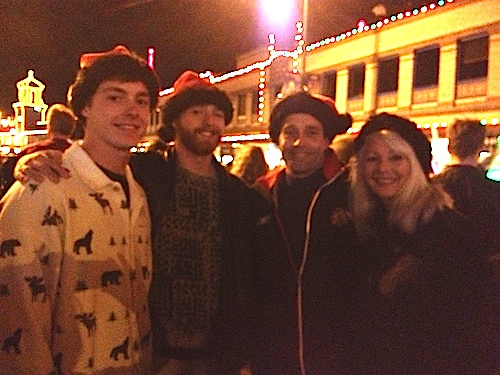
Christmas Day 1970, Our Lady of Mercy Hospital, Dyer, Indiana.
Nan McCarthy
I was nine when our mom took my sister and me to the hospital on Christmas Day to visit our dad. It was the last time we’d see him alive. He died three weeks later of alcoholic cirrhosis. He was 39 years old.
We knew at the time he was very sick. In fact, I remember curling up with my mom in my dad’s favorite oversized green chair one night before Christmas, my head in her lap, Christmas lights twinkling. He’d been hospitalized several times before. “I don’t think he’s going to make it this time,” she told me.
The Intensive Care Unit was decorated for Christmas, and one of the nurses had put a Santa hat on my dad’s head. He was awake, sitting up in his hospital bed. He tried to smile at us, but even at that young age I could see the sadness in his eyes. I don’t think I touched him. I was afraid of all the tubes and how sick he looked.
For many years afterward, Christmas never felt real to me. The happiness seemed forced, superficial. Sure, getting presents was fun. But there was no joy in it. During Midnight Mass, my mom cried.
Then I fell in love and got married. A family of my own. New memories to make. At first it was just my husband and me, a few gifts around a Charlie Brown Christmas tree. But our love was plentiful and genuine. Then our sons were born. More memories to be made. My mom in her pink terrycloth bathrobe, watching us open gifts on Christmas morning, a cup of coffee in her hand and a smile on her face. New traditions, like the Santa footprints in front of the fireplace and a birthday cake for baby Jesus. Our boys jumping up and down in their pajamas, giddy with excitement. Pure joy on their faces. Pure joy in my heart.
Christmas is real to me now. But I’ve learned it’s not just about the happy times. Like any family, we’ve had our share of sad times during the holidays. Living far away from loved ones, missing out on annual family get-togethers. Christmases when one or both of us were without a job and money was tight or nonexistent. My mom’s last Christmas when she was in hospice at our house, knowing it wouldn’t be long before she, too, was gone. The year Christmas was just the boys and me, when Pat was serving in Iraq for thirteen months, his only physical contact a hug from the USO lady on Christmas Day.
I’ve come to realize that even though Christmas didn’t feel real to me when I was young, it was every bit as real then as it is now. It’s just that life and death, sickness and loneliness and tragedy don’t take time off for the holidays.
It’s no wonder Christmas lights, Midnight Mass, and Santa hats held a particular sadness for me as a child. But now I understand how much those seemingly superficial efforts at holiday cheer during the end of my dad’s tragic life mattered. “We’re not giving up on Christmas,” they said. The Santa hat mattered because it held hope. Hope that next year would be better (and if not next year, the year after that). Hope that a frightened little girl would one day make a better life for herself than the hand her mom had been dealt. That she wouldn’t fall prey to addiction the way her father had, even though her DNA was stacked against her. That she would one day find someone who loved and respected her, and together they would bring new life into the world. That they would raise their children to be better human beings than they were, leaving the world a little kinder than they found it.

 Click CreateSpace to order Nan McCarthy’s Since You Went Away (Part One: Winter) in paperback.


 copyright © 2016 Nan McCarthy





 Nan McCarthy